Selecting a teacher

Selecting a Teacher 
There are so many teachers in the world and so many theories about life. 
When selecting a teacher, ask yourself… 
Is my teacher a well-balanced person? Is she or he happy? 
Does my teacher reflect and demonstrate the quality of life I desire? 
If the answer to any of these questions is no, move on in your journey.
Otherwise you may become one of the blind, led by the blind.
Sydney Banks, from The Missing Link

You can exchange the word teacher with other words, such as guide, coach, leader, boss, spiritual guide, enabler. The word doesn’t really matter anyway, but oh, how these words ring true for me.

I remember Lama Kathy Wesley stating in one of my favorite podcasts how important she felt it to be to look at the elders of any tradition of faith that you found interesting. By their appearance, health, harmony, you know, whether or not to venture forth into that tradition or not. In a nutshell, she’s stating exactly the same thing as Syd Banks is pointing to.

And at the same time, well-balanced doesn’t mean a person who is ”perfect”, and never gets out of whack. On the contrary, I would say. I do not require my teacher, coach, guide (yeah, you get it! That whatever-word you place here!) to be ”a perfect human being”, in the meaning that they do not live the human experience.

Because that’s part of the trick for me – living life, experiencing all the up’s and down’s of human experience, and doing it with grace, with balance (that is, returning to balance when off-centered for a moment or two), and a lot of love, laughter and light. Tears commingle with laughter, grief with ecstatic joy, boredom with the feeling of flow where time seemingly disappears. All of that is part of the human experience, but how I live into it, or perhaps, how I live out of it, is what tells a well-balanced person apart for me.
BoldomaticPost_Selecting-a-Teacher-There-areWriting this, I just had an insight.

This quote isn’t only about looking for external teachers. It’s also a great reminder to myself, on my ability to be my own guide and enabler.

When I am well-balanced, happy, reflecting and demonstrating the qualities of life that I desire – then I am a good teacher for myself.

And when I am the opposite (off-centered, miserable, definitely not demonstrating the qualities of life I desire, but rather the opposite), it serves me well to remember to take myself a lot less seriously, as it’s as if I am one of the blind, leading myself. And boy does it hurt when I stumble into all sorts of obstacles along the way, attempting to lead my blind self. In situations like that, the best thing I can do is to pause, to stop in my tracks, and wait for vision to return. Go about my day, doing the routine things that I can do blind-folded, staying clear of making radical decisions, and not expecting too much of myself either. It’s not always easy though.

So am I the only one dumb enough to try to lead myself even when I am in no shape to lead?
Misslyckande är en åsikt

Vad betyder det att misslyckas? Och varför är vi så rädda för att misslyckas?

En av de enklaste och samtidigt mest betydelsefulla förklaringarna på det där med att misslyckas fick jag höra från Dennis Westerberg. Han sa nått i stil med att ett misslyckande är en åsikt. Misslyckandet är inte själva resultatet, för resultatet är till sin natur neutralt. När man sätter sig för att åstadkomma något, så finns två möjliga resultat. Ett önskat och avsett resultat, eller ett oönskat icke-avsett resultat.

Det finns två utfall: antingen får du det önskade och avsedda resultatet, eller så får du det inte. Fakta. Konstaterande.

Misslyckande å andra sidan är åsikten som vi, ganska slentrianmässigt och ofta helt i onödan, lägger på det icke-avsedda resultatet.

Hänger du med? Och håller du med?

Lyssnade till en podcast, minns inte vilken, [Tillägg 15JUN2015: James Clear, The One You feed!] jag lyssnar på så många nuförtiden, som också pratade om detta med misslyckande utifrån ett forskarvärldsperspektiv. En forskare kallar inte icke-avsedda resultat för misslyckande. Åtminstone tror jag inte en forskare som gör det skulle fortsätta i forskarsvängen så väldigt länge. För forskaren är ju även ett icke-avsett resultat en bit information som för med sig mycket värde. Det är en bit information som säger ”Så här får du inte det avsedda resultatet.” och det är väldigt värdefullt att veta, eller hur? Ju fler sådana resultat du samlar, desto snävare blir ju vägen fram, mot det önskade resultatet. (Alla känner väl till Thomas Edison och hur han uttryckt sig i stil med att han inte misslyckats utan hittat 9999 sätt att inte skapa en glödlampa på?)

Steg nummer ett för mig är att se och erkänna det neutrala i att uppnå, eller inte uppnå, ett visst resultat. Att tanken på om något är lyckat eller inte är en åsikt kring ett faktum, snarare än ett faktum i sig självt.

Det andra handlar om varför vi är så rädda för att misslyckas. Och jag skulle tro att du kan se vad svaret är på det också. Rädslan ligger ju i åsikten. Åsikten för vad andra ska tycka, tänka, säga kring mitt ”misslyckande”. Frågan är ju varför det spelar roll?

För egen del, så säger det något om vilken betydelse jag lägger vid en viss människas (grupp av människors) åsikter. Att jag bryr mig om vad någon säger om det resultat jag levererat (vare sig det är det avsedda eller ej), handlar inte egentligen om resultatet i fråga, utan om den personens åsikt.

Den åsikten kan jag faktiskt bemöta på samma vis som jag bemöter mitt resultat – som något neutralt. Vi faller i fällan att tro att någons åsikt spelar stor roll, och har inverkan på vårt välbefinnande, men det är de facto våra tankar om det hela som påverkar oss och avgör vårt välbefinnande.

Jag tar ett exempel. Låt säga att jag experimenterat i köket och lagat mat utifrån vad som finns i kyl och skafferi. Vi sätter oss till dukat bord och börjar äta. Om familjen då är av olika åsikt, dvs barnen tycker det smakar vedervärdigt medan maken gillar det – vad ska jag dra för slutsats av det? Är det ett misslyckande? Eller ett halvt misslyckande? Eller ska jag bara inse att resultatet blev en ätlig middag, som vissa tyckte om, och andra inte tyckte om. Om jag då lägger enorm vikt vid barnens åsikt, oj så misslyckad jag kan känna mig av det. Om jag istället tar det för vad det är, att middagen helt enkelt inte föll dem på läppen, tja, då samlar jag bara på mig fakta som säger att just den hittte-på-rätten lämpar sig bättre för kvällar då barnen inte äter hemma. Neutralt. De facto. Känner jag mig misslyckad då? Nä. För jag har bara samlat information som jag kan dra nytta av i framtiden, eller hur?

Vad skulle hända, om du testade att se på dina resultat framöver som information, som datapunkter, istället för att du ålägger dem en betydelse att de säger något om dig och ditt värde?

Och i synnerhet, vad skulle hända, om du testade att se på dina oönskade och icke-avsedda resultat framöver som information, istället för som misslyckande?

Spelaren och spelet

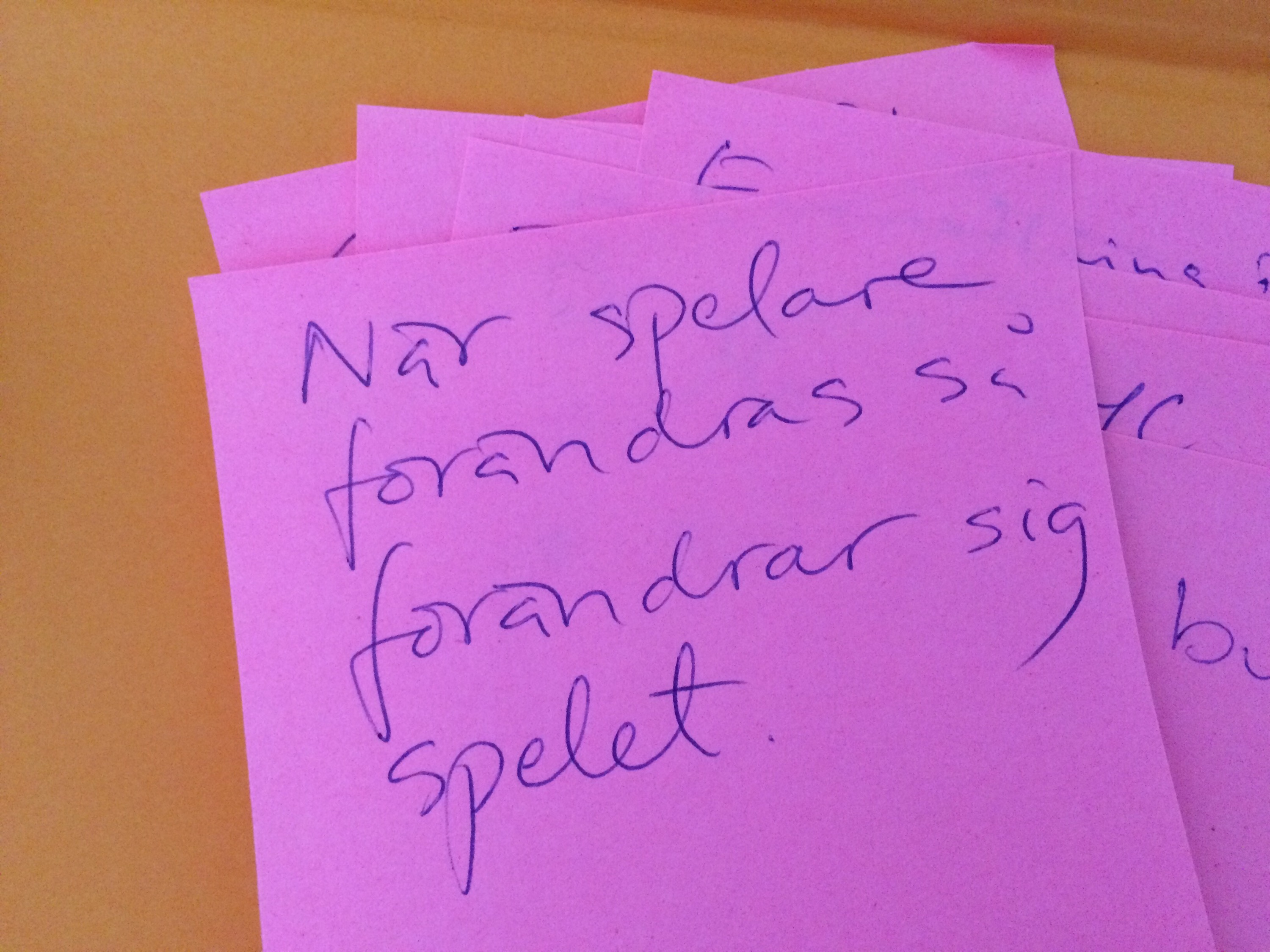
Nånstans nångång tänkte jag följande tanke: När spelare förändras så förändrar sig spelet. Skrev det på en PostIt-lapp som jag sedermera fotograferade och la i min Evernote. Har fladdrat förbi ögat emellanåt när jag varit inne i Evernote. Varje gång så hummar jag tyst för mig själv, för så är det ju. Klart att spelet förändras när spelarna förändras. 

  
Jag kan se det i det lilla, ta familjen som exempel. Om en av familjemedlemmarna förändras – personlig utveckling, plötslig sjukdom, förälskelse eller någon annan av alla otaliga anledningar som kan föranleda en personlig förändring – så förändras dynamiken i hela familjegruppen. Det går även tydligt att se i t ex fotbollslag och dylikt, där en förändring kan påverka enormt, både positivt och negativt. 

Och om det är sant i det lilla, då är det sant i det stora. Det betyder, i mina ögon i alla fall, att jag som enskild individ kan spela oerhört stor roll i att åstadkomma en systemförändring. Jag som älskar att fundera kring stora system och strukturer, och i stort pockar på för att skapa systemförändring, blir samtidigt uppmuntrad av tanken på att man inte måste gå det hållet, dvs förändra spelet i syfte att förändra spelarna. Det är något hoppingivande i att det funkar på båda hållen.

Fast på sätt och vis är det kanske så att individen alltid sitter på trumfkortet. För man kan ändra spelets regler, utan att en spelare förändras, eller hur? Hur många företag har jag inte varit på där omorganisation efter omorganisation lik förbaskat inte föranlett avsedd förändring, eftersom spelarna (dvs medarbetarna) inte köper det nya spelreglerna eller den nya spelplanen. Och omvänt, givet exakt samma spelregler/-plan, så kan allt förändras om spelarna förändras. 

När spelare förändras så förändras spelet. När individer/medborgare förändras så förändras samhället. Samma sak, bara uttryckt annorlunda. 

Så hur förändras en spelare då? Via en tanke. Det är den minsta gemensamma nämnaren för att åstadkomma en förändring i en individ. En tanke. Det är allt som krävs. En tanke, som öppnar för en annan syn på världen. Så enkelt, och hoppfullt. Samtidigt så svårt. För gudarna ska veta att jag ibland fastnar på en tanke, som snarast gör mig än mer fastrotad, och totalt obenägen till ett tankeskifte. Men ett tu tre så släpper jag taget om den gamla tanken, ofta helt omedvetet, och då, med lite flyt, dyker en eller annan ny tanke upp. Där öppnar sig världen igen, där finns möjligheten till förändring. Och händer det mig så lär det hända dig. 

När spelare förändras förändrar sig spelet.

Väcker frasen lika mycket hopp i dig som den gör i mig?

From the deepest despair to the highest hope

Yesterday at the Innate Health conference a man by the name of Dicken Bettinger spoke. And how he spoke. Dicken shared a few stories, one of which related to a troubled teen, and that’s the one that got to me, real hard. A few minutes in on his sharing my eyes started to tear up and by the end I was sobbing, uncontrollably.  

From a place of opposing feelings; from the deepest despair, that we, ordinary people, can innocently be so cruel to each other, to the highest hope, that if you are listened to, by someone who has an understanding of the way the world actually works (inside out), your life can change in an instant.

Does that sound too easy? As if I look at turning from despair to hope with just a thought as something too lightheartedly?

I ensure you I don’t. But I think you just like I, have experienced at least once in your life, a change of heart, where you go from one state of mind to another, in the blink of an eye, in the time it takes to think one thought.

There’s a quote from Sydney Banks that describes this perfectly:

Everybody, everybody, is only one thought away from whatever you’re looking for, if you can find that one thought. And that one thought — do you know what it is? It’s a state of thoughtlessness, thoughtlessness from the little personal mind. This is why people meditate. The second your mind quietens down, what you call divine mind, spiritual mind, spiritual intelligence, spiritual knowledge, true knowledge — all the same thing in different names — comes into being. And you get what you call an insight, that is a sight from within, deep past your personal mind, and all of a sudden, your world changes. 

That’s where my hope lies. In the fact that a change of heart, a shifting of the way I see and experience the world, can happen in a heartbeat, born by the wisdom contained within one thought. That’s hopeful. And I rejoice at the fact that even though I realized the other day that I will not be coming to this type of conferences again (for now at least), I was there yesterday for an experience that shook me to the core. In the very best of ways, mind you, because I only stayed in despair for a short time. The hopefulness of it all takes over in me, and from there, beautiful things can happen. Because I know that anything is possible. That’s the message for me, after these three days at the Innate Health conference: look to and come from love and understanding. Then anything is possible. Anything. Even the seemingly impossible. Such as turning from a world of despair into a world of hope, all of a sudden. Hopeful isn’t it?

Not my format!

I am attending the Innate Health conference in the northern outskirts of London at the moment and today is the last day out of three in total. And I had a realization yesterday right before the conference ended, having noticed something in myself both day one and day two: The standard conference format just doesn’t do it for me anymore. Sitting down from morning til late afternoon, just doing intake – listening to this interesting person, these riveting talks, this panel…. with short breaks and lunch, it’s too much for me. My head get’s filled up already by lunchtime. SImply because it’s all too good! And I’m to stingy to leave – I mean, I’ve paid my ticket, I want to get the most out of it…. That last part is of course something I could learn to drop, but still. I wrote in my note book yesterday that I should avoid conferences and go to retreats instead. 

Doodling during the conference – with the occasional message to myself.

I’ve never been on a retreat as such, but there are several that I’ve considered going to. In beautiful surroundings, with a few intake sessions/day, and plenty of space inbetween those sessions, to make sure there’s time to listen to what happens within during the retreat. It’s in the space between where the magic happens, rather than during a seminar, or a plenary panel, or a full day conference. 

My old self had no such issue with full day conferences. Possibly because I didn’t know that something else existed, or perhaps rather because I wasn’t aware of the magic of the space inbetween. I have learnt to reflect, to sit with myself and whatever wants to show up, these past few years, and these last days have given me the realization that I’ve changed. 

I like that. I love it actually. I love noticing the progression within myself, how what I do/feel/think today differs from yesterday, the year before or decades ago. It’s absolutely amazing, and I am so grateful for noticing it. It points to the limitless possibilities of life, of living on this earth, on having this human experience. As I write this I sit here with a silly grin on my face, feeling extremely happy. 

So. I’ve progressed. Full-day traditional conferences no longer do the trick for me, I have different preferences. Now I just need to remember this, the next time an opportunity pops up. And a few already have popped up I just realized. Hm. Time to act according to my understanding, and drop the ”Well just this one time”-attitude that is so easy to fall into when changes are to be made. What’s your best trick for following your wisdom rather than your old habits, in a situation like this?

Love and understanding

Love and understanding. Yesterday I was reminded, again, that love and understanding is always the answer.   

Asking myself, I know that if I have done something wrong, something I am not proud of, perhaps even ashamed of having done, getting told off, made to stand in a corner to repent, perhaps even being ostracized, that never (!) creates a setting where I dare to truly look within and take ownership of my actions, and know or find a way forward from them, away from them, levelling up, rather than just repeating them over and over. Never.

What does create a setting where I am willing, able, to look within, honestly and consciously, and evolve, is, always, love and understanding. Unconditional. Non-judgmental.  That always does the trick. Given that I step into it myself. That’s the barrier for me. I also need to look at me with love and understanding.

Sometimes I don’t. And then I won’t. Evolve I mean, by looking honestly within. Taking full ownership of myself, my believes and my actions. If I’m stuck in a mode of self-loathing, judgment and disdain, there is no progression. I am stuck. Believing the inner chatter telling me how bad, worthless and pathetic I am, I don’t get away from it. I cannot rise above it, seeing it for what it is: thoughts. Transient, as thoughts are to their very nature. 

But when I step into love and understanding within myself, seeing whatever mindless mental chatter there is for what it is, transient thoughts, not Truth, anything can happen. That’s what I’ve experienced. Anything can happen from that place, the potential is unlimited, endless. Anything. 

And what a place that is to come from, to live from, where anything is possible. Where love and understanding forms the base, the come-from-place. Love and understanding for me. For you. For us. For everything. 

What happens for you when love and understanding is your come-from-place?

A world in or out of focus

Dramatic blue skies.

A small holt of trees, branches slowly moving from the wind.

Out of focus. In focus.

My IPhone had trouble focussing in the dusk.

The image to the left remind me of the way I see the world when I have taken off my glasses. To the right, I have put them on again. I am the filter for my experience of the world. Because regardless if I have my glasses on or not, the trees and the sky remains the same. No difference at all. Except in my perception of them.

And just as I understand that my glasses help me perceive the world around me with greater clarity, I know that sometimes I am in a high mood. When I am, my experience of the world is a world in focus. When I’m in low mood, it’s like I’ve lost my glasses and everything is out of focus. But alas, again, remember that the world itself can never be out of focus. It just it. It is I who am in or out of focus, in high or low mood, and my experience of the world will be shaped accordingly.

In focus. Out of focus.

Constantly shifting. A part of human nature. What makes all the difference in the world is being aware of my mood – because if I see that, I will understand why my world – in any given moment – appears to be in or out of focus.

Mind-made monsters

Here’s another recent thing I stumbled upon, which gives even more support to the exclamation that a change in expectation can make blind people see:

It’s about Sargy Mann, a painter, blind since 25 years. After going completely blind, he once more tried his hand at painting, and experienced the same as that which the Invisibilia-podcast on How to become batman also talks about: that the blind can see. Here’s Sargy Mann’s experience in his own words, which you can also hear yourself in the YouTube-clip:

BoldomaticPost_So-I-brush-aquamarine-up-ther

The way the mind and our thoughts shape our world, never ceases to amaze me. And it’s not about believing I can or not. (Even though that certainly can help or hinder my progress.) It’s about testing. It’s about picking up that paint brush filled with aquamarine, it’s about exploring the world which is there regardless if I see it or not (consider totally blind Daniel Kish riding a bicycle, a good example that blows my mind when I think about it!).

Is it perhaps about understanding, that whether I believe it or not, that’s thought and not truth, and there is only one way to find out: by doing.

Not having mind-made monsters limit me, living my life, for fear of something or other.
Not having to fight those mind-made monsters either, because then I create a battle ground in my mind, and try to get ready to fight. But – what I forget then is this simple fact: If the monsters are mind-made, then the fight is as well. It’s all make-believe.

Understanding this means that my relationship with my mind-made monsters is rapidly changing, and has been changing for the past two years or so. I now see them for what they are. Not for what I believe them to be. And that makes a big difference. It makes it much easier to not limit myself because of mind-made monsters. It doesn’t mean I don’t create monsters, because I do. I just don’t engage with them any more, in that imaginary battle, that is so energy consuming. I’ve spent enough energy in pointless battles with imaginary monsters, and I fail to see how that serves me or anyone else in any way.

So more or less (depending upon my state of mind in the moment!), I just don’t do imaginary battle anymore. Do you?

Podcast 8/52 – Dinner with Einstein, Jung and Herbie Hancock?

Listened to this episode of Peak Prosperity the other day, and since then have listened to it another two or three times. It’s a conversation between Christ Martenson and Andrew ”Treebeard” Graves on becoming the change we wish to see, and exploring the development of inner resilience.

And they go deep into stuff that really resonates with me in many ways. Sometimes perhaps simplifying a bit much, but still, there’s a lot of what they speak about that I agree with.

So, since I’ve talked and written much the past quarter on listening for that which I don’t already know, I’m now challenging myself to write about what I heard that was new to me… hm, let’s see… *reading through the transcript of the podcast, trying to find something that sticks out as new to me*

First of all, listening to this conversation as such, on a podcast such as Peak Prosperity surprised me, but also made me quite happy, because I’m hoping it will resonate with the Peak Prosperity community, and will lead to even more people actually starting to look within.

And also, I’d like to join in on that dinner conversation with Einstein, Jung, Herbie Hancock and Chris Martenson. I sort of knew Albert Einstein have said something like this: “People think I had these great ideas, but it was not me. I just opened myself up and creativity flowed through me. I was a vessel.” but I had no idea Carl Jung and Herbie Hancock felt the same. I actually had to google Herbie Hancock, because I’ve never really listened to him. Found a great tune quite fitting to the theme of the podcast itself actually:

Imagine all the people living for today.
Imagine all the people living life in peace.
Imagine all the people sharing all the world.

Now there’s a vision to dream of.
I do. I dream of that, and I try to act it too. I see the potential for it, the possibility that exist in every moment. A world where we live as one. And becoming the change we wish to see in the world is the only way to get there, I believe. Do you?

Typiskt! När man har en dålig dag möter man bara skitstövlar.

Häromveckan skrattade jag högt åt Nemi i Sydsvenskan, det måtte varit en söndag eftersom det är versionen som inte enkom är en strip utan nästan en hel baksida av kulturdelen. Tog raskt ett foto och tänkte Det här måste jag lägga upp på bloggen! Så då gör jag det:

Nemi

Jag hoppas du kan läsa. Om inte kommer här själva poängen (sista rutan):

Typiskt! När man har en dålig dag möter man bara skitstövlar.

Ja. Just precis så är det. Och vet du varför? För när jag har på mig jag-hatar-världen-för-alla-är-idioter-glasögonen på mig, ja, då ser jag ju världen genom de glasögonen och allt jag upplever färgas av min sinnesstämning i stunden.

Och lika sant är det då att när jag har på mig jag-älskar-världen-och-jag-älskar-alla-människor-för-de-är-underbart-mänskliga-allesammans-glasögonen på mig, ja, då ser jag ju världen genom de glasögonen och allt jag upplever färgas av min sinnesstämning i stunden.

Grejen är att jag har dessa, och en sjudundrandes massa andra glasögon i min garderob, och det är inte alltid jag är medveten om vilka som hamnar på nästippen. Men när jag blir medveten om vilka glasögon jag ser världen genom, så blir också världen och jag själv, lite enklare att fördra. För när jag upptäcker att jag sitter där med mina alla-är-en-idiot-glasögon på så är det nästan som om de liksom löses upp och försvinner i det blå och lämnar plats åt några nya. Och då kan ett annat par glasögon närmast magiskt hoppa upp på nästippen min, och så upplever jag världen helt annorlunda än alldeles alldeles nyss.

Så är det. I varje stund upplever jag världen utifrån den sinnesstämning och de tankar och känslor jag har. Har du tänkt på vad det betyder egentligen? I. Varje. Stund. 

Själv vet jag detta. Men likförbaskat fastnar jag ibland i tron på att det finns vissa undantag. Snurrigt det där. Som om gravitation vore ett tillval jag kunde göra, när det passade mig liksom. Så är det ju inte (med mindre att jag befinner mig i omloppsbana en god bit från jorden eller något dylikt), utan gravitationen påverkar mig i varje stund, oavsett om jag är medveten om den eller inte. Så funkar min upplevelse av världen också.

Fast ibland vore det bra skönt om gravitation och det faktum att min sinnesstämning i varje stund avgör hur jag uppfattar världen runt mig kunde vara tillval, om så bara för en minut eller två, eller hur?