Drop the agenda

What happens when you drop all thoughts on having an agenda, and just do this:
* Show up
* Respond to what shows up

These are two points that Michael Neill talk about, and I’ve only recently started to experiment with it. For real. And I can tell you, what I’ve experienced so far makes me want to try this even more, on more occasions. For one thing, coming to a meeting with another human being, without an agenda, without any thoughts on wanting this person as a coaching client, on me knowing what would be the best thing for this person in this instance, on wanting to help or fix this person, means that I am more present to the situation at hand. It means I am not already dead set on how to go about it, what will be the outcome, having fixed goals for what I want to happen, etc. And that really makes it easier to experience touching the silence. It makes the meeting much more real, somehow.

Now. It’s actually not so easy, I’ve discovered. Or, at least, it’s not something I am used to. Quite the opposite. I’m used to being prepared, knowing what to say, what to show, and often times, having a clear agenda as to the desired outcome. And somehow, when I am there, with a clear agenda, the magic is missing. Something’s missing. It falls short, not really living up to its potential. Not fully becoming all in the moment that it could be.

Two other things I’ve noticed about this:
First, I believe I would have a much harder time showing up without an agenda, if it was something I was not certain about, or knowledgeable about, perhaps is more the word for it. That is, if you asked me to go deliver a speech about the state of EUs financial policies and structures, I’d freak out. There is not way I would be able to do that in this manner of showing up. Because I have no clue whatsoever about the financial policies of the European Union. Go find someone else, who knows this stuff, please. But ask me to come talk about my dream of changing the school systems on a global scale by 2020, and I can just show up, and respond to what shows up. Without a doubt. I might not do it that way, but it’s an area where the possibility of it happening is much greater that the first example.

Second, this is not the way society is set up, somehow. When did you last show up, without an agenda? If you go to the doctor, you want the doctor to diagnose you. The doctor meets a patient, with the same agenda, to help the patient. Teachers meet their students with very clear agendas, on What learning should take place, and often times, How. You go to the bank, wanting a loan. Not just to see what shows up. You make a business appointment, wanting to sell your brilliant idea, or to get a hand shake on a joint venture. 20140508-214622.jpgI could think of thousands of these instances, where showing up with an agenda, is what is – mostly – done.

And yet, the magic happens, for me, when I drop it. When I drop the agenda, drop what I WANT to happen (sometimes oh so desperately!), just show up, and respond to what shows up.

Does this make sense to you?


Den snäva normen

Vi lever i en värld av problematiserande. Överallt ser jag individer, organisationer, myndigheter, företag som problematiserar. Som har tydliga normer för hur man ska vara, se ut, bete sig, agera. Faller någon utanför normen så problematiserar vi gärna detta. Och gör vårt bästa för att avhjälpa problemet. Fixa det. Lösa det. Få problemet att försvinna.

Och många gånger undrar jag om inte det är vårt tänkande kring problemet som är problemet, snarare än problemet i sig. Har skrivit om det innan. Och det är på något vis som att jag fått upp ögonen för detta, på riktigt, på sistone.

Ponera att någon i din omgivning ”har ett problem”. Är det personen i fråga som upplever det? Eller är det du, och andra runtomkring, som tycker att det där är ett problem? Är det verkligen ett problem? Finns problem på riktigt, eller är det just hur vi tänker kring något som gör att vi uppfattar det så? Blir det ett verkligt problem tack vare att vi tänker problematiserande kring det? Blir det kanske tom till, just av den anledningen?

Jag vet inte jag. När jag började knattra på detta blogginlägg var mina tankar grumliga, och jag upplevde att jag var långt från klarsikt, för jag var mitt uppe i ett sånt här problematiserande skeende. 20140506-173731.jpgSedan dess har det gått ett par veckor, och fast jag fortfarande inte är säker så har jag agerat, och bestämt mig för att inte problematisera. För jag vet inte om det verkligen är ett problem, eller bara ”ett problem” som jag och omgivningen skapar för att det faller utanför ramarna. Något som inte är som det brukar. Ska man då fixa, avhjälpa, återföra till fållan, till normen? Eller ska vi försöka vidga den där förbenat snäva normen?

Doing the right thing?

Åsa Minoz sent a link on Twitter the other day, as a response to a discussion on whether or not calling oneself PRO or ANTI actually makes any difference. Well, both me and Åsa believe it does make a difference. I am a pro-person myself, getting energized by the possibility to move ahead, to create, to reach something, somewhere. There are anti-people as well, who get equally energized by that position. We complement each other, in my view, and I am not (any more, thank god for that!) an advocate for My way or the highway.

Since I watched the clip that Åsa linked to, I have managed to send it to many people, because it’s just the most eloquent (and funny!) way to describe a system and its parts, so please, give Russ Ackoff 15 minutes, and watch/listen to him talking on Beyond continual improvement:

A few of the gems hidden within this talk, in my view, are these:

”If we have a system of improvement that is directed at improving the parts taken separately, you can be absolutely sure that the performance of the whole will not be improved.”

”Any process improvement effort 20140429-210259.jpgmust be focused on what you want, and not on what you don’t want.”

”Quality ought to contain a notion of value, not merely efficiency. That’s the difference between efficiency and effectiveness. Quality out to be directed at effectiveness. The difference between efficiency and effectiveness is the difference between knowledge and wisdom. And unfortunately, we don’t have enough wisdom to go around.”

Are you busy doing things right or doing the right thing?

Birth rights

One of my Facebook-friends shared something beautiful on her wall the other day, and when I asked if I could quote her, the answer was an unequivocal yes:

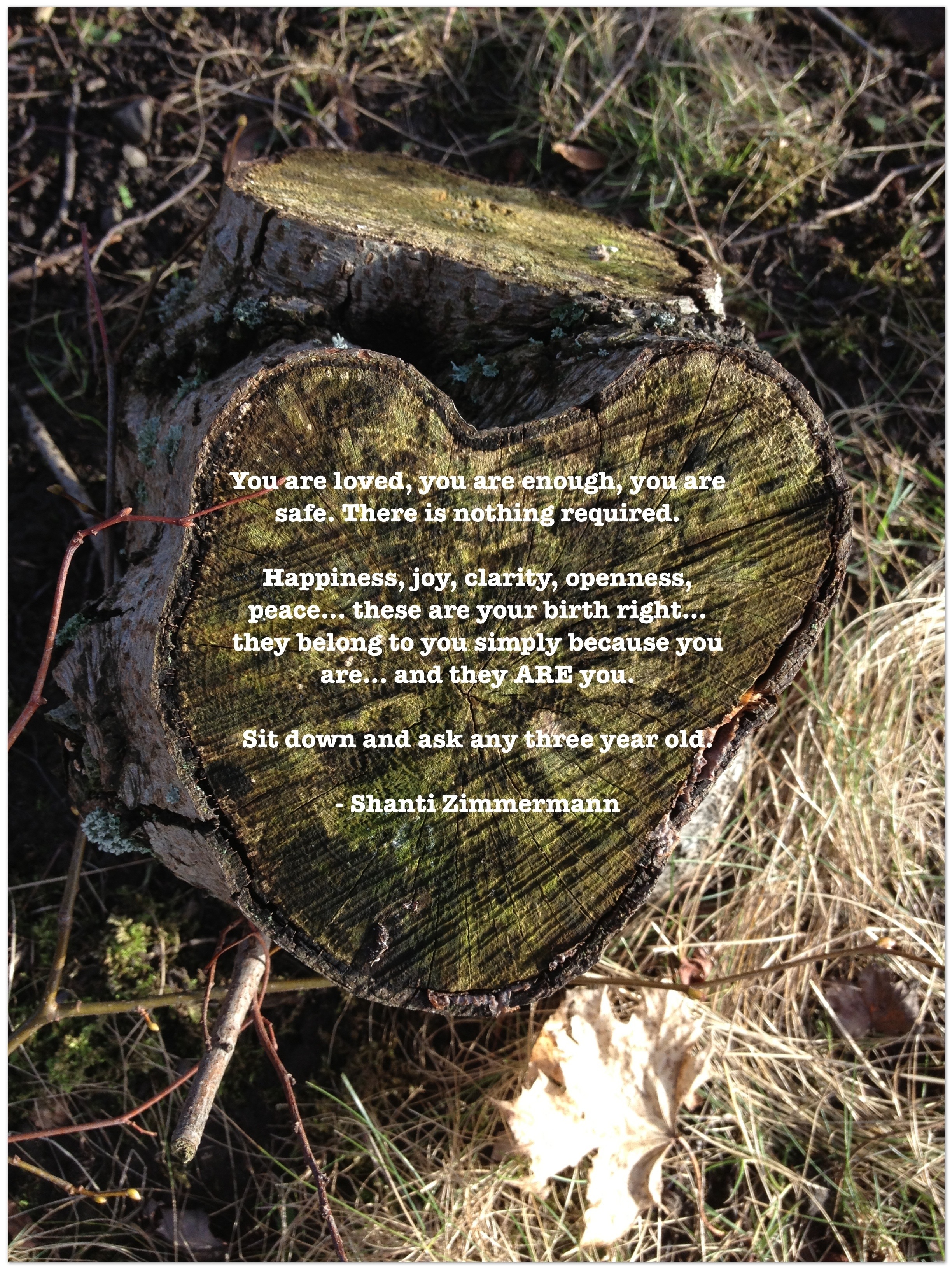
You are loved, you are enough, you are safe. There is nothing required.

Happiness, joy, clarity, openness, peace… these are your birth right… they belong to you simply because you are… and they ARE you.

Sit down and ask any three year old.

-Shanti Zimmermann

20140304-134023.jpgWhat opens up within you, reading this about your birth rights?

The art of forgiveness

On the art of forgiving by the way, inspired by Hector Black.

I’ve not been best friends with forgivness for a while. Or perhaps best friends isn’t the word for it, but there is something about the way we use it, that rubs me the wrong way. I think we abuse it, telling kids to Say you’re sorry! for almost everything, and brushing it off afterwards, as if that’s that.

The Swedish author Ann Heberlein wrote a great book on forgiveness (in Swedish alas, the title being ”It’s not my fault, on the art of taking responsibility”, and it is thought provoking. She tells a story of a kid being bullied at school. When the bullies wanted to say they were sorry, the victim of the bullying refused to accept their apology, and all of a sudden the tables turned. Suddenly the bullies felt like they were the victims, as their victim refused to forgive them. The original victim of the bullying was more or less ostracized by both kids and adults at the school because she would not accept the apology.

That story gave me a lot to think about, I tell you. There is power in forgiveness, that way we use it, and somehow I feel we might be misusing it?

20140415-084621.jpg

Who am I to tell someone to ”say you’re sorry”? And who am I to tell someone to accept that apology?

But I got some new insight into the concept of forgiveness during the first SuperCoach Academy weekend in Santa Monica, when Michael Neill said something like this:

To forgive means to make like it never happened. When you forgive, it means that you essentially go back in time to before what ever it is you forgive took place. If you are not willing to do that, there is no forgiveness.

That was a new take on forgiveness that I have not pondered before. It makes my thinking tumble along, doing a cart wheel or two on the way to more understanding and insight. Putting it into the Heberlein story on the bully and the bullied, I guess the victim of the bullying simply wasn’t willing to act like it never happened. And hence, forgiving her assailants wasn’t an option.

Have you ever thought of forgiveness in this way?

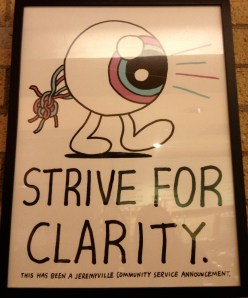
Strive for clarity

At Tender Greens, Santa Monica, they had these pictures on the wall, with the most profound messages. I’m gonna share them with you because I think they are worthy of being shared, each and every one. They are of the same quality as the Tender Greens food is, if you ever have a chance to try it, do!

Strive for clarity

Since so much of the Three Principles of Mind, Consciousness and Thought, are about clarity, I took this as a good sign. We all have an innate wellbeing, but sometimes our thinking get’s muddled. It can be like a snow globe, which when shaken just turn a white blur, like a snowstorm. But if you let the globe be, it will settle, and there will be clarity. The same goes for our thinking. Once we stop trying so hard to think things through, moments of clarity usually come, and you just know the answer to whatever issue you were struggling with. Ever had that happen to you? You stop thinking about an issue, and at the gym, in the shower or driving your car, you suddenly get it? Had any recent moments of clarity?

The Mandala of Love

During the final day of Supercoach Academy Connection Weekend I was doodling, like I usually do, and the sum of the entire SCA2014-experience until that very moment came to me.

20140319-035205.jpg

It truly is all about love. Love is the answer. Regardless of what the question is. Love is it. Humans have unlimited capacity to love. However, I don’t use my unlimited capacity to its fullest, but I sure am working on it. And the funny thing is, the more I love, the better my life gets.

I feel love for you. Yes, You!
How does that make you feel?

SCA2014 Connection weekend, day two

Wow, what a day. Mara Gleason was our guest teacher/guide/conversation partner for the day, and it’s been a ride alright!

But it actually started with me finding Silvio down at the cafeteria of the hostel when I came down for breakfast, and he asked if I wanted to take a walk up to Columbia University. So we did, and it was really nice. Extra special since my little brother went there recently – looked like a really nice campus to spent time at!

20140315-040711.jpg

Took the tube to Times Square, where I got off to walk the last blocks to the venue for the training. Two major things happened there today, major for me that is. The first was when I volunteered to be coached by Mara, which gave me reassurance concerning an assignment I’ve just taken on. The second was a one-on-one coaching exercise where my SCA-colleague Sacha Ivis guided me through a very significant meeting with one of my oldest and still alive & kicking squiggles.

Only SCA2014-participants might get the meaning of that right now, but there will be more on it here, sometime, for sure. But briefly, squiggles is what happens when I get stuck on a thought, and just can’t seem to let it go. Feels familiar?

Skillnaden som gör skillnad

Så säger min nyvunne vän Dennis Westerberg, som är ytterligare en pärla mitt liv berikats med sedan #skolvåren-resan började på Twitter en februarikväll 2013. Han är fascinerad av skillnaden som gör skillnaden, och jag märker att det där är något jag verkligen gillar. Det får igång mig.

20140310-210503.jpg

Det är dessutom en fantastiskt bra fråga att ställa, använder den både på mig själv och mina coachklienter:
Vad är skillnaden som gör skillnad?

Ställde frågan till min dotter också, i samband med att hon kände att hon fått ökad förståelse för ett område som de arbetat med i skolan. Hon tänkte en stund och sen samtalade vi lite om hennes funderingar. Hon landade i att hon inte accepterat att hon inte förstod, utan att hon varit ihärdig och ställt frågor tills hon nådde känslan av förståelse som hon eftersträvade.

Vad är skillnaden som gör skillnad i ditt liv?

Ögon som ser

Samtalade med min make om det här med förändring, och hur man på ett bra sätt tar tillvara och upptäcker de utrymmen till förbättring som finns i en verksamhet.

Han inledde vårt samtal med att säga:

Ta vilken verksamhet som helst och bjud in människor utifrån, så kommer de att finna den potential till förändring som finns. De som jobbar där har, om inget annat, en nedsatt förmåga att se, men de som är nya har öppna ögon, de har ögon som har en förmåga att se.

20140225-152439.jpg

En av grundförutsättningarna för detta är ju dock att jag, som ny/utomstående, inser vilken styrka jag besitter, just därför. Under min senaste vända på Yrkeshögskolan Syd i Hässleholm, där eleverna bland annat får öva på SWOT-analyser, utifrån vilka möjligheter de har att få jobb efter utbildningen, var det en deltagare som sa ”Men jag har ju ingen erfarenhet, vilket för mig blir en svaghet.”.

Jag frågade henom om hen kunde se någon styrka i det, men det kunde hen inte. Och det gjorde mig lite ledsen. Så jag sa just detta – dvs, att styrkan som ny just är fräscha ögon som kan se. Och minsann om inte det gjorde åtminstone en av deltagarna lite tryggare i känslan att faktiskt ha något unikt att bidra med, inte till trots, utan tack vare, bristande arbetslivserfarenhet inom sagda yrke!

Vad har dina ögon förmågan att se?