Experiment more!

Yesterday me and my business partner Ulf had a brainstorm around the purpose of our mutual endeavors, and really diving deep into the question Why was great fun. While we were brainstorming, laughing, lunching and planning, several things from the Tai Lopez-podcast from London Real that I recommended last week popped up for me. It made me realize there were many things that I’ve been quietly digesting since last weekend when I listened to the show twice.

These things in particular were very well suited to the wild ideas and discussions of yesterday:

* Experiment more – but never longer than 18 months. If it’s not good after 18 months, cut your losses and get out!

* Double down – meaning: do more of that which works really well, the actions that serve you and your business, making a profit, as well as learning, growing, staying and getting fit and expanding as a human being.

* Friends & family – surround yourself with friends and family, and double down on relationships with people close to you. It’s not about having the highest number of friends, make each friend really valuable instead. money

* Fuel units – that’s what Tai calls money. Fuel units. If you have a car, you need fuel units to make it move. Same goes with everything else. We need fuel units to make things happen in the world, and with them you can do good, just as you can do evil. But since the golden circle (our Why) for me and Ulf is ”to make the world a little better”, we’re opting for doing good.

Just a few tidbits of the three hour long Tai Lopez-interview on London Real, but tidbits which I am playing with, in my head, and in my conversations. And, as importantly, in taking action as well. I’m playing with the idea of looking at all action taken, all courses laid out, all plans, conversations and endeavors I engage in, as experiments. Nothing is permanent. Everything is in movement, constantly shifting. Decisions are made, in the moment, but very few of them are written in stone, even though I have certainly been guilty of treating many decisions as being permanent. And then, in a heartbeat, something happens and life get’s flipped upside down. So why not play around and experiment more?

No elephants in 10 years?

Did you know that elephants and rhinos are killed at a rate that will have them extinct in ten years? I didn’t. And boy do I ever want to help stop that from happening. So when I stumbled upon Air Shepherds, I knew I wanted to support the endeavor, which just might be the saving grace of elephants and rhinos, with a little luck and a lot of help from me, you, and everyone else!

Image courtesy of Air Shepherds

Image courtesy of Air Shepherds

Air Shepherds uses drones and supercomputers to stop poaching, and the results have been amazing! To quote from the IndieGogo-page, where I hope you’ll also pledge to help air shepherds stop more poachers, this is what’s happened where Air Shapherds have operated:

”Poachers operate under the cover of night, and until now, rangers have not had an effective way to find them before they kill.  We fly drones, unmanned aerial vehicles (UAVs) that have infrared cameras and GPS on them and can send back thermal images of animals . . . and poachers. They’re electric, silent and invisible but provide the information operators use to rapidly vector rangers to the location of the poacher before he kills.

It works. Flying in one area where as many as 19 rhinos were killed each month, there have been no deaths – for six months.  None at all.”

Amazing results. Zero poaching. This sure is a beautiful marriage of technology and human endeavor! And I for one sure want to do what I can to stop elephants and rhinos from going extinct during my lifetime – for manmade reasons! – so I have pledged a sum of money and hope you’ll do the same. I also urge you to spread the word, to help make this crowdfunding campaign a successful one. I for one am rooting for The Lindbergh Foundation getting a lot of money from this campaign, making it possible to set up new Air Shepherd-teams all over Africa in areas where poachers are ruthlessly killing elephants and rhinos.

BoldomaticPost_In-wilderness-I-sense-the-mir

There is nothing like witnessing nature in all its grandeur, but we are destroying it at an alarming rate. Perhaps our scientific accomplishments can ensure our grand-children and future generations to come will also be able to sense the miracle of life so present in the wilderness?


Podcast 13/52 – tossed in a tumbler for 3 hours!

black tumblerPodcast tip number 13 and I thank Michael Sillion and his PodOfTheDay-blog for this episode, which had me feel like I’ve just been through a 3 hour ride in a tumbler. Sometimes exhilarating and sometimes just really confusing. (Maybe actually being tossed in a tumbler would only be sheer hell, but work with me here, please.)

The podcast I’m talking about is London real with Tai Lopez, and once I’d finished the 3 hour long episode I actually pressed play once again. Am now almost two hours done second time round, and I’m vacillating between nodding vigorously, totally agreeing, and then once in a while I shake my head, get a sceptic look on my face and absolutely disagree with some things.

And you know what? I love that. I love the perplexity of the grey scale, of not saying ”I absolutely agree with 100% of everything Tai says” but not going ”I don’t believe a word this dude is saying” either. I like that, because it pushes my boundaries, expands and challenges my understanding of the way of the world, and gives me something to take a closer look at.

I almost get short of breath when listening because Tai speaks so much and fast, and Brian Rose of London Real does nothing to slow him down. London Real somehow very macho, and I haven’t listened to a lot of London Real episodes for that reason, but this one. Yeah. It works. For me. Somehow, despite the length, the tempo, and all the parts I disagree with. Funny that. Does it work for you?

Boys and girls

Boys and girls. Blue versus pink. Cars against dolls. Rowdy or mild-tempered. How we almost expect a teenage boy to have scruffy clothes and stink of sweat, while we would be horrified if it was a teenage girl. Excusing certain behavior with ”boys will be boys”, while expecting girls to help fellow boys in Kindergarten put on gloves, tie their shoes and zip up jackets.

I could go on forever, listing things, habits, colors and much more, that for some reason have been deemed either to be for boys. Or for girls. Men and women too, of course.

I don’t want to do that though.

What I want to do is have you read this article: 10 Words Every Girl Should Learn. And once you’ve done that, you read this article as well: Beating the Toy Aisle Blues (and Pinks).

Read them?

I read them, and went bonkers. Then I stumbled upon this as well:

iwrotehtearticle

Oh. I just remembered another example of the absurd world we live in, as well. I read another article (or a Facebook-update?) the other day, about a lady who had stopped moving over whenever she came upon people when walking, to see what would happen. Guess what she found out? Women move over. Men do to. But not all of them. I think she was up to a count of having collided with 26 men (and zero women), when she shared her observation with the world. And you know what? I actually tried it out the other day, when I was talking a walk in the park close to home. I was walking along, came upon a man coming at me, and I suddenly got it into my head to try it out for myself! We would have collided if he hadn’t moved, which he did, in the last instant. I am grateful for him for moving over, but what I found most interesting was how uncomfortable it felt NOT to move over. Extremely uncomfortable.

So. There I go. I am a person who moves over. Which in itself is not a bad trait, not at all. But it’s interesting, the feeling I got when I didn’t. When I was hell bound on standing my ground so to speak. Makes me think about my own behavior, how much of it which is truly Me, and how much is culturally accepted behaviors I’ve learnt the hard way, which might, or might not, serve me, but which I perform automatically, without giving it any thought. Makes me think of the way of the world, and the culture I am a part of co-creating on a daily basis, moment by moment.

Oh well. There’s plenty do to in the world, to make it a better place, a place where I can be me. Regardless of what that means (within moral and legal constraints of course – unless the law is discriminating itself, which unfortunately is the case in many places where for instance homosexuality is outlawed, just to name but one absurd example). Being me. And a place where you can be you. Period.

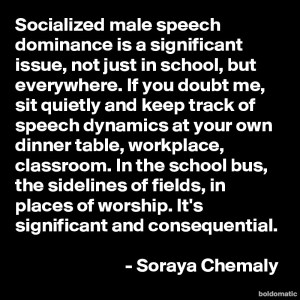
So. Here’s a challenge (or rather, many!). For me. Definitely. But perhaps also for you? I’m gonna observe my surroundings for a few days, to see if I can spot this:

BoldomaticPost_Socialized-male-speech-dominan


Moderation or All-or-Nothing?

Today I pushed myself beyond my normal routine of doing a #Seven in the morning (Seven is an app – using the hashtag #SevenApp – which gives me 12 exercises to do, 30 seconds each, with 10 seconds of rest in between each), and did Seven times five instead of just one time around.

I did the workouts that have unlocked in my app (every second month of daily Sevens, a new workout with 12 new exercises gets unlocked):Seven times five
Full body
Upper body
Lower body
Random (random picks of the unlocked exercises, my favorite workout!)
Stretch

And I have to tell you – that was really nice. I’m gonna try to do a round of Seven times five on a weekly basis, if nothing else for the wonderful feeling I have in my body right now. Arms, legs, chest, stomach and back, well, really my entire body has that heavy feel to it, from being utilized and stretched a bit beyond its normal use.

Doing a little bit of exercise on a daily habit works really well for me. And after 219 days of daily Seven’s I can feel the difference. So much so that today, I was able to do Seven times five, which I would have been hard pressed to accomplish 220 days ago.

Goes to show that a little bit, done in moderation, really does make a difference in the long run. Even though we often fool ourselves into thinking it’s All or Nothing. And I know for myself, that when I set very ambitious goals, and then one day fall through, based on my belief in the All or nothing-scenario, I usually become a drop out from my own goal. And doing these smaller, more moderate habits, have really helped me come to terms with my faulty thinking around All or Nothing, which generally, doesn’t serve me. So, I simply shrug my shoulders at those thoughts, when they come sneaking in, which they do from time to time. But I generally don’t entertain them.

What about you? Moderation rings a bell, or you’re an All or Nothing-kind of person? What usually serves you better?

Podcast 12/52 – why we are here!

Yesterday I had another one of those ”Wow, this podcast is so good, I want to listen to it again, as soon as I’m done listening to it the first time around”-moments, and the podcast that made me all excited was the One You feed-episode with Glennon Doyle Melton.

I found a lot of really significant passages in the conversation in this podcast, and a few of them went straight to my heart. One of them centers on the habit we have of not sharing our vulnerability with each other. Glennon tells a story of when she wrote a post on Facebook, sharing her vulnerability in 25 bullets. The response was amazing and supportive, but also, people dared to show their vulnerability with her, after she had shown her. And she was struck by the fact that people she knew, she only really thought she knew, because there was so much pain and hard experiences in their life, that they had never shared with her. She shares her reaction to this, in the podcast:

I was pissed! Because what are we doing? Why are we even calling each other friends? We sit together and we’re talking about things that do not matter, and you’re in so much pain, and I have the same pain. This just gotta be what we’re here for: to talk about this stuff! 

hold backNow, why is it like that? Why do we barely go skin-deep? Why is it so hard to be vulnerable? Why do we hold back, from sharing our pains, losses, grievances, but also our joys, tender moments and highest wishes and dreams? And why do we believe the mind-made monsters about what will happen if we are wholehearted and vulnerable, when  in my experience, usually it’s the opposite. Yes, there will be haters, but haters will be haters, to quote Taylor Swift, and why should we (or I) let that stop me? And what I have received in love and connection on account of opening up and being vulnerable, far surpasses the ”hate-responses”.

And still. I hold back. I shy away. I hold my tongue, for fear of the reaction, even though I know that if someone came to me with what I am dying to share, I would open my arms and heart and just hold a space for whomever it was who shared their vulnerability. Why don’t I think others would do the same for me? Isn’t that why we are here?


Three things I know to be true

Michael Neill shared a TED Talk in his newsletter the other day, and it’s a TED Talk to watch. More than once. It’s rich.

It inspired Michael to share three things he know’s to be true in his newsletter. I was inspired to share the newsletter with a friend, asking for his three true things, and whaddayaknow, I got the question back:

What are three things you know to be true?

It sat in my email inbox for a few days, but at this very minute (which was at 10 pm Thursday evening of March 19th, 2015, when I replied to the email), this is what I know to be true:

1) That the shortcomings of human beings is our greatest gift, because when paired with awareness and consciousness, the shortcomings carry a message, a loving message.
2) That I absolutely love the silence that occurs during deep connection, the silence that is so rich it can be touched. It can occur when I meet myself, and when I meet others. In any instance, it’s like touching wonder and magic.
3) Spring is on it’s way, my face is still tingling from the heat of the spring sun, which I spent a marvelous four hours in, earlier today.
What are three things you know to be true?
This blog post, number 20 of 100, is a part of the #blogg100 challenge currently running in Sweden

Mind-made monsters

Here’s another recent thing I stumbled upon, which gives even more support to the exclamation that a change in expectation can make blind people see:

It’s about Sargy Mann, a painter, blind since 25 years. After going completely blind, he once more tried his hand at painting, and experienced the same as that which the Invisibilia-podcast on How to become batman also talks about: that the blind can see. Here’s Sargy Mann’s experience in his own words, which you can also hear yourself in the YouTube-clip:

BoldomaticPost_So-I-brush-aquamarine-up-ther

The way the mind and our thoughts shape our world, never ceases to amaze me. And it’s not about believing I can or not. (Even though that certainly can help or hinder my progress.) It’s about testing. It’s about picking up that paint brush filled with aquamarine, it’s about exploring the world which is there regardless if I see it or not (consider totally blind Daniel Kish riding a bicycle, a good example that blows my mind when I think about it!).

Is it perhaps about understanding, that whether I believe it or not, that’s thought and not truth, and there is only one way to find out: by doing.

Not having mind-made monsters limit me, living my life, for fear of something or other.
Not having to fight those mind-made monsters either, because then I create a battle ground in my mind, and try to get ready to fight. But – what I forget then is this simple fact: If the monsters are mind-made, then the fight is as well. It’s all make-believe.

Understanding this means that my relationship with my mind-made monsters is rapidly changing, and has been changing for the past two years or so. I now see them for what they are. Not for what I believe them to be. And that makes a big difference. It makes it much easier to not limit myself because of mind-made monsters. It doesn’t mean I don’t create monsters, because I do. I just don’t engage with them any more, in that imaginary battle, that is so energy consuming. I’ve spent enough energy in pointless battles with imaginary monsters, and I fail to see how that serves me or anyone else in any way.

So more or less (depending upon my state of mind in the moment!), I just don’t do imaginary battle anymore. Do you?

Podcast 11/52 – what am I blinding my children to?

I’ve already recommended the entire Invisibilia-podcast series in one of these podcast recommendations, and I do suggest you listen to each and every show. But here’s a specific episode which is just mind-blowing. At the end, the hosts had me dancing in the street (was outside taking a walk while listening) as I answered YES to the question:

Do you think if we changed our expectations blind people could come to see?

The episode is called: How to become batman and centers around Daniel Kish, a blind man (since he was 13 months old) who since early age uses echolocation to get around.

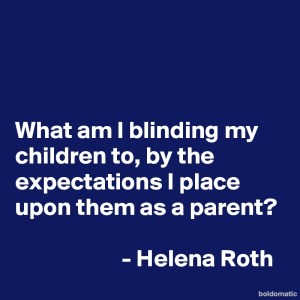
BoldomaticPost_What-am-I-blinding-my-childreWhen I listen to how his mom raised him, I got really quiet, and looked deep within at how I raise and have raised my children.

Paulette Kish faced the question if she was going to raise him like a seeing child, allow him to explore his world with very few restrictions on him for blindness?

Now. My children are not physically blind. So that specific question has never been a question for me to ponder. But still, as I listen to this show, and hear the story of Daniel, and of his mother, I cannot help but wonder what I am blinding my children to, by the expectations I place upon them? And correspondingly, what am I opening them up to, by other expectations? Are these expectations intentional or unintentional from my part? How aware am I of my expectations, and the result that can spring from them?

Preparing for life

Alan Seale wrote about Preparing for life, a 17 minute long film about a Waldorf school in California, The Waldorf School of the Peninsula, in his newsletter. He wrote about it in a way that spiked my interest and curiosity, so while having lunch I watched the film:

Now. There’s a lot going on in my mind as I watch this, as I take in what I see and hear. Some of those things are questions like:

  • Is it just this school or is this film representative (in spirit, if nothing else) of all Waldorf-schools? *how I wish for the latter*
  • Why haven’t I found a school like this for my children to attend? *feel sad, that I haven’t*
  • Is there even any schools like this in Sweden? I know there are Waldorf schools, but are they truly like this one? Same same but different, perhaps? *hoping I will find out from friends who work in and with Waldorf schools in Sweden and Norway*
  • Why don’t all kids get a chance to go to a school that truly give’s them access to this:
    To know the world is to know the self, and to know the self is to know the world.

But also thoughts such as:

  • Within the existing school system paradigm, this is probably as good as it gets.
  • But still, how strange it is that we toss kids together with other kids the same age, and sprinkle in a handful of adults, and keep them all in a classroom, or two, within the confines of a building called a school house. This is not natural for humans, it’s not what we are wired for, physically or psychologically.
  • Not surprised that the TV-reporters use dramatic words of ”totally unplugged school” when that is not what the teachers and students are saying at all. But headlines require the use of drama to get attention right?
  • Amazing eye sparkles going on here, as well as relationships, learning, and creations – I mean, witness some of those paintings and sculptures – they look like they were made by a professional!

All in all, Preparing for life leaves me with a feeling of hope. It show’s me it is possible to make something really great out of the concept of school, as it stands today, and looking forward, there’s every opportunity to create a school system where all children truly will be able to thrive and explore their human potential.

What are you left with after watching the film?