
Podcast 32/52 – A special treat for you!

In Sweden we have an old radio tradition dating back to 1959 called Sommar i P1. That means ”Summer in program 1” and I’ve never heard it presented in anything other than Swedish. However, for some reason, of which I am very grateful, one of the best episodes of this summer, with environmental scientist Johan Rockström, suddenly showed up, in an English version. He gave his original Sommar-show in Swedish, and if you know the language, I’d recommend that. But if you aren’t one of the fewer than 10 million people worldwide who know Swedish, please make sure you listen to the English version!

As a person with a strong environmental interest there were a lot of facts in this podcast that I already knew about. Some that I think I’ve forgotten but now have a revived understanding about, and, interestingly enough, quite a few new facts and figures to me.

BoldomaticPost_I-support-the-Earth-StatementJohan Rockström provides some devastating pieces of information, regarding our world and what humans are doing to it, but he has an optimism to him, that makes this episode strangely uplifting, despite the grim realities of climate changes and the likes, that we face.

One of the things that Johan Rockström have initiated is The Earth Statement, which is something I had not heard of before I listened to this podcast (which I’ve done three times, by now), but since then I’ve become a supporter, adding my name to the list of many others.
Check it out yourself: http://earthstatement.org or perhaps you already have?


Design to the edges

Here’s Todd Rose, on The Myth of Average, from a TEDxTalk that I’m hoping you will spend 20 minutes listening to:

When we design for the average we destroy talent.

Why?

Simple. No one is average.

Average people simply don’t exist, as proven by the US Air Force many decades ago. So designing for the average means we don’t design for anyone. Even before Todd started to draw parallells into the educational system, my mind had made a frog leap there, because if ever there was a system designed for the average, it’s that one.

So what can be done to combat this talent destruction? The US Air Force decided to ban the average, and go from designing to the average, to designing for the edges instead.  When will this create the changes we desperately need within educational systems across the globe?

Podcast 31/52 – Asking is not receiving

Podcast recommendation 31/52 from the Good Life Project marks the return of ordinary counting in this series. I went off the deep end and named two blog posts after each other number 27… Oops. Anyway. Here I am, back on track full out, it’s week 31 and here’s the 31st podcast recommendation in this year-long series.

BoldomaticPost_When-asking-for-help-make-surSo here it is, an episode from Good Life Project with Jonathan Fields, that I listened to a couple of times yesterday, as I was picking black currants. A short riff on something that I haven’t really given a lot of thought to; the difference between asking for help, advice or assistance, and being open to receiving it.

Asking is not receiving.

As I am writing this post I am listening to it once more, and there’s something to this short story that touches me. This sequence in particular makes me pause, and reflect, looking deep within:

There comes a time when you need to stand naked and silent in the room.
To not just lower the shields, but keep them down. 

Are you open to receiving?
To standing naked and silent?
If so, the real work begins…

How do you Do virtues?

I listened to Parker Palmer giving this commencement address to the graduating class at Naropa University, and several times I got goose bumps and shivers. For me, those have become telltale signs that there’s something important and/or very true being shared.


The six suggestions Parker provides on living a life worth exploring are simple. And powerful. So powerful I followed my urge to split this recommendation into six consecutive blog posts. You can read my thoughts on the first, second, third, fourth and fifth suggestion here.

BoldomaticPost_Daily-keep-your-death-beforeThe sixth suggestion is: ”Daily, keep your death before your eyes.” – St Benedict
If you hold a healthy awareness of your own mortality, your eyes will be opened to the grandeur and glory of life, and that will evoke all of the virtues I have named, as well as those I haven’t, such as hope, generosity and gratitude. 

We get to chose what virtues we hold high, which ones we try to model in the world. And the beauty is, we get a new chance to do so – model it, I mean – over and over again, moment by moment. And in a strange way, there is no tomorrow. Well, of course there is a tomorrow, but postponing my way of showing up in the world until tomorrow, that’s risky business. Because you might not be around tomorrow, and that’s a fact. There will come a tomorrow when I am not here, in this form at least, and the worst thing about that for me would be if I never got around to showing up as me, with my virtues and values held high, because I kept pushing it forward to the next moment, the next moment, the next moment.

Yes, it can be tricky to live according to your values. We are only human after all. That’s why it’s so important to be gentle with ourselves in our humanness. At the same time – it will never get less tricky, less awkward, less strange and unfamiliar, if I don’t start to act in accordance with my view of these virtues. And that’s actually something to ponder as well. I mean – virtues are all fine and dandy, love, hope, understanding, generosity, gratitude and so on. But how do I do them? How to express them in the world? How do I live in accordance with them, so that my actions mimics my beliefs? How do you do love for instance? Or gratitude?

John Cleese and Groundhog Day

Just finished reading John Cleese autobiography So, Anyway… which is a book I recommend even for those who, like me, haven’t really got the British comedy scene from the 60s onwards down pat. One of the foremost insights I had when reading was how apparent it is that life unfolds, in mysterious ways, and how going with the flow of life can lead to fantastic careers, such as John Cleese’s.

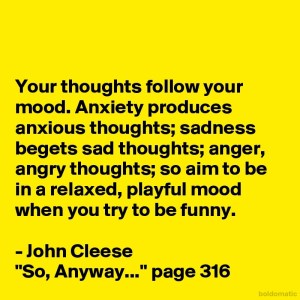
But besides that, he talks a lot about writing (he sees himself first and foremost, as a writer rather than an actor), and stipulates a few rules for writing funny stuff, the second of which I really enjoyed reading:

BoldomaticPost_Your-thoughts-follow-your-moo

This I’ve found to be true: My emotions are a guide to my current state of mind, or mood, to use John’s words. I react to the world, from my current internal mindset, rather than have the outside world create my mood. I find this important!

It’s a bit like Groundhog day, you know, the movie with Bill Murray, where he keeps on reliving February 2nd, over and over again. The same things occur, and depending on his current internal mood, he’s happy, sad, angry, annoyed, depressed, frustrated about it. The same things. But his mood determines whether or not he perceives it to be good or bad, happy or sad, cheery or boring. This is true also in my life, as well as your’s, and is not a movie-feature.

If I’m in a miserable state of mind, I will see all things through that lens. It’s not the miserable things of the world that causes me to feel miserable. My mood tints the world into appearing miserable.

If I’m in a happy-go-lucky state of mind, I will see all things through that lens. It’s not the happy things of the world that causes me to feel happy-go-lucky. My mood tints the world into appearing happy-go-lucky.

One day I knock over a glass of water on the kitchen table and you would not want to be around me, for all the shouting, swearing and cursing going on, ruining my entire day and giving me ample evidence the whole world is out to get me. Another day, I laugh at my own clumsiness and after wiping it up just goes about my business, without a single cuss-word crossing my lips.

Have you experienced that as well, where the same things happened twice in a row, but your reaction is totally different?

On compassion

compassion

Continuing my collaboration with Sus and her marvelous ladies, prompted by a query from my coach on yesterday’s doodle on judgement. She read what I’d written and added: …and practice self-compassion for our sweet, humble humanity when we notice we have ”fallen into judgment” yet again….

She continued with wondering what my compassion sketch would look like, and that thought crept into my conscious mind during this morning’s meditation. So I brought out my IPad, Paper and Pen, and started doodling. A few botched attempts, and then I sent the text above out into MIX. Send a note to Sus asking if she was up for another collaboration. She said she’d gladly give it a go, and immediately got it right, with little Miss Balancing-Act above.

That’s what it can feel like for me, balancing in life. Putting one feet out in front of me, not knowing if I’ll wobble and fall, or stand steady, ready for the next foot to move ahead. But the real balancing act is about meeting both situations (the wobbly as well as the steady journey ahead) with compassion, for me, and for everyone else.

Realizing how I’m not the only one stumbling through life – occasionally falling down, sometimes in a flow – but this goes for everyone. We are all balancing our way through life. All of us.

Now, there’s a thought to sit with…

On judgement

judgement

My friend Sus found this Paper-doodle by me in MIX the other day (FiftyThree, check it out!) and pimped it with a toe-tapping highly judgmental Miss Know-It-All. She sent it to me and I was rejoiced! What a great reminder. Because that’s just how I feel at the moment. I fall into judgement daily, especially when checking my Twitter-feed. And then I judge myself for judging and not being compassionate…. A vicious cycle as you can understand. So I’ve decided to skip checking in on Twitter for the rest of the summer, adding this restraint onto my summer social media challenge.

Avoidance? Yeah. Spot on. But why not? I mean, I don’t enjoy a lot of what I read on Twitter at the moment, I don’t enjoy my reactions to it, and I end up feeling miserable, cursing some people, and feeling sorry for others. So why go after that feeling?

Nah, I’d rather spend my time on activities that I enjoy and take pleasure in. Like picking cherries, cooking cherry jam, gooseberry jam and marmalade and picking Bishop’s Weed for tomorrow’s lunch pie, all of which I’ve done today. Good trade-off wouldn’t you agree?

Podcast 29/52 – Bearing witness

Here’s a new recommendation for you, at long last! I have tons of episodes from On Being, Good Life Project and One You Feed that I’d love to recommend for you, but I also want to give you a taste of something new. So here’s Rich Roll in conversation with Andy Puddicombe, the voice and co-founder of Headspace, the meditation app that I’ve been using for almost a year now.

I’ve just listened to a few episodes of the Rich Roll Podcast, and I will be recommending some more as time goes, but the episode with Andy was really interesting, in part because I honestly had no clue to Andy’s extremely unusual background! I might be the only one in the Western world who’s missed out on that story, but… go figure. There I was, anyway. Rich and Andy cleared that up for me though, which I am happy about. Because Andy has lived a life with a story worth telling, that’s for sure.

BoldomaticPost_Most-people-assume-that-meditI’ve never taken to meditation before. Haven’t really tried, properly, and never got interested enough to actually give it a go. And I’m quite happy about that actually, because I sure had it wrong.
Andy got it right, in this quote. That’s the mis-conception that I had. That meditation was a way to stop the inner chatter, the endless jabber, that’s accompanied me all my life.

Perhaps lucky for me, I’d already gotten an understanding of how thoughts work, how they shape the world as I experience it, and what with daily blogging (being a form of self-coaching for me) for a couple of years, I’d gotten pretty ok at stepping back from myself, bearing witness.

So when I started on the Headspace-journey, I had absolutely no wish, desire or ambition for it to help me ”stop my thoughts”. Not at all. I just really enjoyed giving myself 10-15-20 minutes a day devoted to stepping back and bearing witness, just being with myself. Sometimes in absolute calm. Sometimes agitated as hell. And not getting caught up in either of those states, but rather just seeing it, seeing me, in the moment.

Anyway. Whether or not you meditate or if you really loath meditation and such mumbo-jumbo, this interview is worth listening to, in my view. And if, by chance, you get interested in the Headspace app and want to give it a go, start with the free 10-day routine, and then let me know if you want to try more. Because I have a 30-day voucher to give away to someone who want’s it! Might it be you?


A part of being human

I listened to Parker Palmer giving this commencement address to the graduating class at Naropa University, and several times I got goose bumps and shivers. For me, those have become telltale signs that there’s something important and/or very true being shared.


The six suggestions Parker provides on living a life worth exploring are simple. And powerful. So powerful I followed my urge to split this recommendation into six consecutive blog posts. You can read my thoughts on the first, second, third and fourth suggestion here.

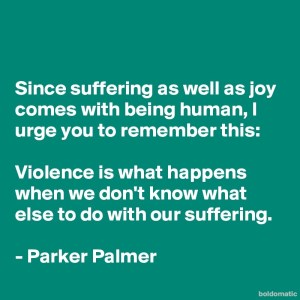
BoldomaticPost_Since-suffering-as-well-as-joThe fifth suggestion is: Since suffering as well as joy comes with being human, I urge you to remember this: Violence is what happens when we don’t know what else to do with our suffering.

As Parker says, violence can be directed inwards as well as outwards. And it’s not the answer, it’s not. Hardest for me has been to stop being violent inwards. Beating myself up, verbally, in the harsh and terrifying inner chatter, that accompanied me for so long. It’s almost weird trying to look back at it. I have a hard time remembering what it sounded like, specifically, because it’s so far from the inner chatter within me right now. My mental chatter has shifted, and as a result. I don’t suffer as much either. It’s like a merry-go-round. I suffer, beat myself up over something, and then suffer more, think I’m a wimp for it, so I beat myself up over it some more…. and so on.

And now. A totally different tone. A gentleness. Towards me. And to think I only realized it was possible to be gentle towards myself around my 35th birthday. (Born in 1972, you do the maths.) When I stopped being harsh on myself (and yes, I do believe that to be a form of violence) something else became possible. Because at that time not only could I could start to take in all of my own feelings, I could also start to take you in. And with that, your suffering no longer scared me (as much anyway). Being less likely to want to thrash out, verbally or physically, at your ways to try to escape your suffering. Understanding it doesn’t say much – if anything – about me, and everything about you.

Me being ok with feelings of suffering (both my own, and yours), those same feelings seem to pass through me quicker and more easily. The rabbit holes of my past used to be so deep it took me forever to get out of them. Now I fall into them, but not as deep, and not for as long. Maybe because I no longer fight desperately to get out of them?


Podcast 28/52 – Stewardship, not disruption

I’ve not followed Brain Pickings a lot, but now and again I stumble upon something coming from that site, and it’s almost always magnificent. Making me wonder, kick-starting my curiosity and often being very inspirational. Then I listened to Maria Popova of Brain Pickings in a conversation with Krista Tippett from On Being.

Guess what happened after I was finished listening? I pressed PLAY once more, and took in the entire episode once more. I believe I’ll listen to it over and over again. Because there’s so much interesting stuff in this podcast, beautiful sentences, phrases, stories about Marias grandparents, and much else. It’s hard to pick out one or two things, because it’s truly an episode worth listening to in full.

But the sentence below, which is a quote by a friend of Marias, really hit home. Perhaps because I’ve been talking about the need for personal stewardship with a friend of mine. How it’s a word, and an activity, that we seem to have forgotten, I believe.

BoldomaticPost_Culture-needs-stewardship-not

Sitting here looking at that quote ”Culture needs stewardship, not disruption”, my mind took a leap. To cultivation itself. To the no-dig no-till practice of cultivation put in use by Paul and Elizabeth Kaiser, that I got so enthralled by in the Peak Prosperity podcast. They explained how disruptive it is for soil structure, and hence, for soil-living creatures such as a majority of all wild pollinators, when we dig, till and uproot plants from the ground. They work with nature, rather than against it, and boy, are they rewarded!

There’s more for me to discover here, I can sense it lurking just beneath the surface. So I’ll sit with it, letting it take its time. Sooner or later it will emerge. I won’t try to dig for it, because that would likely just disrupt the process.

Does this quote evoke anything in you?