8/24 – Putting life on pause

reassurance

Do you think I should do this? Or that?
What do you think of this? Or that? 
Which one do you thing I should choose? This one? Or that one?

Reassurance. Asking for someone outside of yourself to make your choice for you. In a sense, that’s actually what it is. Putting the power over your life and your choices, in the hands of somebody else. What for?

You run the risk of being put on pause. On hold. Waiting for the response from your father, wife, boss, co-worker, teacher or best friend. Not being able to move on, using the energy of the moment, because you are… what? Afraid you might make the wrong decision? Might pick the wrong thing? Walk down a path you should not have chosen?

Letting others choose for you might seem like an easy way to live life. But is it really your life then?

Reflection #8 of 24 from the notes I took and the experience I had at the Seth Godin Q&A-session in London, November 2015. These reflections will constitute my Advent Calendar for 2015, and will be posted daily from December 1st to the 24th.

7/24 – Learning is da shit!

My daughter told me over dinner the other night, that a lot of her friend’s parents are pushing them hard for good grades, using threats of not getting to do or have stuff they want and so on. So when she said ”I am so happy you don’t push me that way. I know you are happy if I do my best, and learn as much as I can, regardless of the grade I get”. standard

So in a sense, I’ve been striving towards this family standard that Seth spoke about, quite a few years by now.

I asked my daughter: If you would get top grades but not learn a lot, or not so good grades but learn a lot, which do you think I’d opt for? She replied immediately, picking the latter choice. And she’s right. Learning is much more important for me than grades. Grades might (and should!) be a reflection of how much and well you learn, but really, I don’t think that’s how they work at all. You can learn an astonishing amount of stuff, and still get a low grade. It all depends upon your starting point, doesn’t it? Unfortunately the effort put into learning isn’t taken into consideration in grades.

Asking for, and praising, top grades, might be a strategy that backfires on you, as a parent. You run the risk of promoting external motivational factors, rather than encourage inner motivation. Instead, ask for, and praise, learning and the work your child (and yourself!) puts into it!

Reflection #7 of 24 from the notes I took and the experience I had at the Seth Godin Q&A-session in London, November 2015. These reflections will constitute my Advent Calendar for 2015, and will be posted daily from December 1st to the 24th.

6/24 – Podcast 49/50 – Taking a risk

I didn’t want to give up recommending a podcast Sundays in December on account of the Advent Calendar I’m running with quotes from #SethinLondon, so I realized I might as well find some podcasts with Seth that I haven’t recommended before (because I’ve recommended several before: this 4-part blog with Seth at On Being, and this one from GLP.)

Seth Godin London Q&A by Rajesh Taylor

Seth Godin London Q&A by Rajesh Taylor – did we ever have a blast that day!

So I googled. And got lucky. There’s a multitude of podcasts featuring Seth Godin! And I can understand why, since he’s an interesting person to have a conversation with. I started to listen to Smart People Podcast and have to say, even though the episode with Seth is from 2013 I think, it’s definitely a ”conversation that satisfies my curious mind” which is their tag line.

At the end of this podcast, Seth actually talks about what I’ve been starting to do this past year, which is, to not just go for ”the next, the next, the next” all the time. Rather, I rarely listen to a podcast, to give an example, but once anymore. I almost always listen at least two, and often three or four, times. This podcast is no exception. On my second listening, I heard more. Deeper. More profoundly.

If you’re into school and learning, sharpen your ears especially about 19 minutes into this podcast. It’s good. And I mean G O O D what Seth says there!

But. My absolute takeaway from this podcast is a simple mantra. I wanted to find the spot, so I’ve been listening, and re-listening, while packing for a trip, and I simply cannot find it. Makes me wonder if I heard it somewhere else, which is a definite possibly as I’ve been listening to a lot of Seth these past days.

Anyway. I know Seth talked about this (somewhere!), and what I heard was something that goes like this: Every day try to be generous in a risky way.

That really spoke to me. Generous in a risky way. Going out on a limb. Not walking the straight and narrow. Au contraire. Taking a risk, with the definite aim at being of service.

Now.
How do you do generosity in a risky way?

Reflection #6 of 24 is a bit of an odd ball, as it’s not from the notes I took and the experience I had at the Seth Godin Q&A-session in London, November 2015. Rather, this is a reflection on a podcast with Seth Godin. These reflections will constitute my Advent Calendar for 2015, and will be posted daily from December 1st to the 24th.

5/24 – What is school for?

How do I as a parent prevent my kids from loosing their inspiration?
Should I take my kids out of school?parents at fault

Now, if you’ve followed Seth you know he is a staunch critic of the current school system, but besides the fact that it’s a industrialist system designed (originally) to produce compliant cogs, he actually took me a bit by surprise here. Because he blames parents. (Now I’m not into blame games normally, but he has a point.) Parents should be asking what is school for, of everybody, anyone with a power to make changes, on all levels. And since everybody actually does influence somebody else, this really is something to ask of everybody.

What is school for?

Or, to use the twitterified question of the Swedish movement #skolvåren (translates to school spring): #WhySchool?

But, the real answer to the question affected me even more. Seth said that there is one thing that he loves about public schools and that is the fact that it’s such a mix. Where a kid from the projects can sit next to a kid with a billionaire mother. A kid with five older siblings, who never got a brand new piece of clothing in his life, can sit next to an only and severely spoilt child. (Perhaps a current risk we are facing is that the eclectic mix seems destined to become a thing of the past, the way the school system is run at the moment?)

So rather than think that you have to take your kid out of school, look at what you can do outside of school. In the afternoons. Weekends. Holidays!

Edit Wikipedia articles together, help your kids set up a blog to write in, give them a camera, buy them (or you all) a Raspberry Pi to experiment with, go to museums and art galleries, play together, read books, write books! Join a local toastmasters club, play instruments and sing together, travel the world, or go walk-about on roads in your local area that you’ve never walked along before. Grow vegetables in the garden, or sow a sunflower seed in a small pot of soil, get chickens for your backyard, cook together. Have fun! Live, love, laugh!

So even though, generally speaking, we don’t have a school system designed to create free-range kids, that doesn’t mean your kids can’t become free-range kids anyway. (What a free-range kid is? Check out this post: Part 4, Seth at On Being!)

So just get cooking! Homeschool (or unschool if that is more to your liking) your kids after ordinary school is out for the day, the week, the semester, the year! There is so much more to life than school, and learning for life can take place just about anywhere and anytime. I think the reason this affected me such was that I’d somehow forgotten about this little fact. But now I’ve been reminded.

Reflection #5 of 24 from the notes I took and the experience I had at the Seth Godin Q&A-session in London, November 2015. These reflections will constitute my Advent Calendar for 2015, and will be posted daily from December 1st to the 24th.

4/24 – The urge to hide

I don’t even remember the question that led up to this:dolphin

”Oh no, not me, what should I say? What should I do? Do I look good? Is my hair ok? Who will see this, and what will they think of me?”

All those can be read into that ”Eh…” in the note I took.

In other words – human beings have a tendency to worry about what others might think, rather than just be in the moment, and go with what wants to happen.

Why is that? Where does it come from? And when does it come? Because surely we are not born with a detrimental and depressingly downputting self-deprecating inner dialogue?  One that we actually don’t have to listen to even, and still, it’s as if we think it’s telling the Truth. Why is that?

Reflection #4 of 24 from the notes I took and the experience I had at the Seth Godin Q&A-session in London, November 2015. These reflections will constitute my Advent Calendar for 2015, and will be posted daily from December 1st to the 24th.

3/24 – How do I do Trust?

One of the things that have really impressed me with Seth Godin is how he uses one element to navigate his work (and I presume life) by: Trust.

I remember listening to him in a podcast saying he determines what to do or not, by asking a simple question of himself: Does this scale trust? 
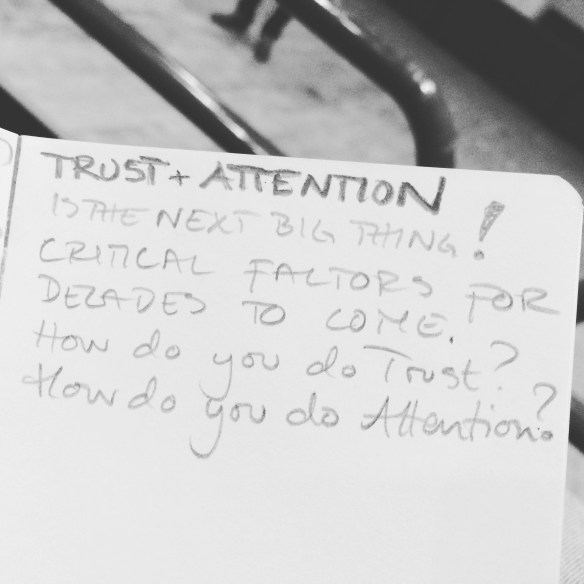
If the answer is Yes, he goes ahead. If No, he moves on to the next thing.trustSo when asked something akin to ”What will be the divider between those who make it and those who don’t, in the coming years?” he replied Trust and Attention. That is what will determine what we see, hear, shop, eat, where we work, the clothes we wear and so on in the decades ahead.

Now. I understand what he means with Trust, or so I believe at least. The level of trust I hold for someone, something, depend upon what they do, how they do it, and or me, why they do it in the first place. If there is coherence there, and it fits in with the way I show up in the world, I will trust.

But what does he mean with Attention?

Is it this: Those who works out a way to get attention from the masses, will be makers and shakers ahead regardless of what the product is? Somehow I don’t think so.

Might it be this then: Those who knows how to scale trust, and has a great product (a physical or digital object, a service, whatever your thing is) to put out into the world, will attract the attention of those who vibrate on the same frequency?

Or this: That which I put attention on is what I will see more of in the future?

Or something completely different?
I don’t know. What’s your take on it?

Reflection #3 of 24 from the notes I took and the experience I had at the Seth Godin Q&A-session in London, November 2015. These reflections will constitute my Advent Calendar for 2015, and will be posted daily from December 1st to the 24th.

2/24 – Love those bad ideas!

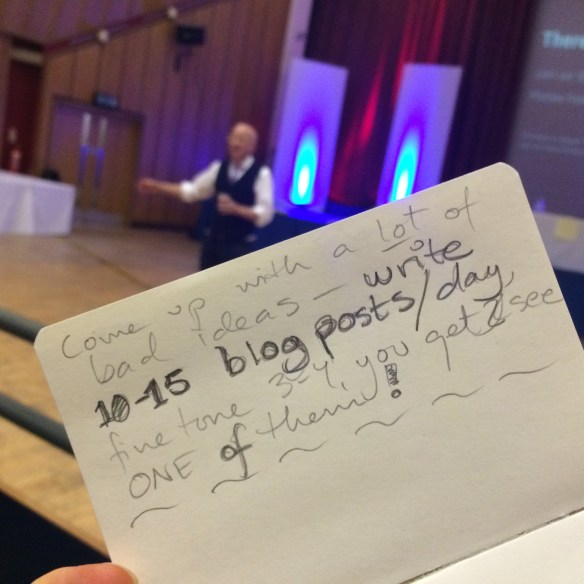
Seth Godin was asked how he manages to publish such great content on his blog, daily, without fail. His answer, short and sweet, was to come up with a lot of bad ideas.Note one #sethinlondon

What the world gets to see on his blog, is the result of a ruthless culling. Seth told us he writes ten to fifteen rudimentary blog posts a day, fine tunes three to four, and finally decided which is the best. That’s the one we, as his readers, get to see.

This chocked me. And from what I heard of my fellow participants at #SethinLondon, this was one of the things that really stood out for a lot of us.

I mean. I’ve set my sights on blogging daily, and I do, more or less. Have been doing it for soon to be three years now. But I’m still at that stage where I’m happy that I write one post. I mean, sometimes I do write more than one post, but rather than cull them from possible posts to publish on account of not being good enough, I save them for a day when my inspiration is lacking. Which means, you lot aren’t as lucky as the blog readers of Seth Godin are. His readers know what he publishes has been through a quality check, of sorts. My posts, very little quality control in my blogging process, I have to confess. I write, and then I publish. Seldom do I throw it away, thinking it’s not good enough to publish. But perhaps I should start to question my postings a bit more?

Oh well. I’m not putting myself and my blogging down though. I do learn. A lot. I mean, my writing is improving, based on this aim of mine to blog daily. But since I’m actually starting a new blog, solely in English, come the new year, perhaps I should set a higher standard with a lower frequency for that blog? Blogging three times per week, making sure what get’s published is up to the mark?

Reflection #2 of 24 from the notes I took and the experience I had at the Seth Godin Q&A-session in London, November 2015. These reflections will constitute my Advent Calendar for 2015, and will be posted daily from December 1st to the 24th.

1/24 – Merely begin.

Where do I start?
How do I know what is the right project, work, next step for me?
How do I know?begin

That was the gist of one of the questions asked of Seth Godin at #SethInLondon. And Seth beautifully answers:

Begin. 
Merely begin. 

It doesn’t matter what you pick, as long as you pick. That is the clinch, you see! Picking. Not what you pick. But the act of picking and then taking step one, step two, step three, and so on, putting your effort into whatever it is you picked.

I think as you get used to picking, you also get better at it, learning from previous picks that might have totally bombed, or just didn’t really feel right after a while. As long as you keep on picking and continue to move, to act, to do work that matters, stuff may or may not be smashing successes or total disasters. Keep on picking. And then. Most importantly: You begin.

Reflection #1 of 24 from the notes I took and the experience I had at the Seth Godin Q&A-session in London, November 2015. These reflections will constitute my Advent Calendar for 2015, and will be posted daily from December 1st to the 24th.

Podcast 48/52 – how to be together?

As I was making raw food balls I listened to another maker, Ann Hamilton, in a conversation with Krista Tippett, from an episode of On Being, and as seems to be the norm these days, once I’d listened to the entire show, I pressed play yet again.

In a Times interview before the new millennia, Ann stated ”I want to bring to the surface the questions we should be asking” and Krista asks her what that question is today.

How to be together.” That’s her answer, and then she continues ”That seems like the biggest question. How to be together?”.

Look around you. Look at how we are towards each other. How do we interact? How do we disagree, without belittling or abusing our opponent? How do we maintain healthy relationships with people in our lives?

Look at yourself to start with, and how you are with yourself. But also, how are you with your closest family and friends, your colleagues, your circles of support? And what about going yet another step further towards the periphery: How are you with more distant acquaintances, in your social media circles and the like?how to be together

I, for one, struggle with this. Daily. Or, perhaps struggle isn’t the right word. Because I don’t fight with this. But I do take care, deliberately try to consider my actions in the world, to make sure that I make a positive impact. And the question really comes down to this:
How do I act in the world, moment by moment, so that I am true to myself, while at the same time interact with those around me, close or far apart, in a way that is congruent with my worldview?

Hyvens Salong med tankespjärnande samtal

Städat. Röjd undan högar. Handlat. Lagat soppa. Förberett skålar med morot, och yoghurt. Dukat. Tänt ljus.

Före

Sen. Dyker de upp. En efter en. Initialt kom Ulf, min Hyvens kompanjon. Därefter. Gäst på gäst. Totalt sju personer, inklusive mig och Ulf. Alldeles lagom. Slevar upp soppa och går och sätter oss.

Kort introduktion av själva konceptet, som inte tarvar många ord. Huvudpoängen – att lyssna efter det du inte redan vet. Inte lyssna för bekräftelse, utan efter det andra, det som vidgar dina vyer, ger dig tankespjärn, sätter griller i huvudet på dig. Så väldigt enkelt. Och gisses, så svårt. Vanan att lyssna efter bekräftelse sitter där, stark, väldigt inarbetad, så djupt rotad att den blir osynlig. Jag märker inte ens att jag lyssnar på automatik, utan att faktiskt höra vad som egentligen sägs.

Kort presentation av de som sitter runt bordet och sörplar soppa. Och sen är samtalet igång. Böljar fram och tillbaka, handlar mycket om framtid och organisation. Om Varför. Motivation och engagemang.

efter

Tiden går snabbt. Innan jag vet ordet av har två timmar gått och det är dags att säga farväl, för denna gången. För jo, det blir fler Hyvens Salong. De är alldeles för intressanta och givande för att upphöra. Att under ett par timmars tid, få sitta i ett möte med människor som framför allt har ett gemensamt, i att vara nyfikna och öppna, ger mig ofantligt mycket. Jag lär mig, expanderar. Och att det inte har något syfte utöver att just bara vara en plats där ett samtal kan föras, ingen dold agenda, inga krav på resultat, progress. Att bara få vara, tillsammans med andra. Nästan absurt, men…. i mitt liv är sådana tillfällen oerhört sällsynta. Har du skapat utrymme för något dylikt i ditt liv?