Podcast 20/52 – total flip!

Today I’ve listened two times to a podcast that flipped my world. I had no idea. There’s so much in this episode of The One You Feed that poked at what I have previously known to be true, and now feel might not be. I am definitely eager to check out what Portugal has been doing, for instance, that’s for sure. And if what they seem to have done has been so radical, and successful, why haven’t I heard more about it?

Ok. By now you might be thinking, what has she meen smoking to get all woozy like this?

Well. Nothing. I swear. But interestingly enough, the episode is actually centered around the war on drugs. Check it out for yourselves, the episode is The One You Feed with Johann Hari, on the demons we face, and why waging war on them might only have gotten them to grow ever stronger… I for one am definitely gonna check out his book Chasing the scream, that’s for sure!

I also wonder if your guess on the percentage of people who use any type of drugs (legal or illegal) who ever have a problem with it is as off target as mine was?

Light travelling – undervalued!

I flew to London this morning, to attend the 3P conference on Innate HealthI will be away for four nights, and I must say I am very pleased with the size of my luggage. Travelling light is really undervalued, I must say. I have yet, even though I get better at better at light travelling, to come home without something that could have stayed at home because it simply didn’t get used during the trip. Maybe this trip will be a first for that? There’s one thing I forgot though, my travel adaptor stayed at home. Luckily my Airbnb-host had one I could borrow. I immediately put travel adaptor in the template packing list I just created in Trello the other day. 

I did a post in Swedish with a few of the things I’ve started to pay more attention to before/during/after travels, but I am sure there are tips and tricks I’ve yet to learn, so please share yours, if you have any?

Bye bye, beloved friend!

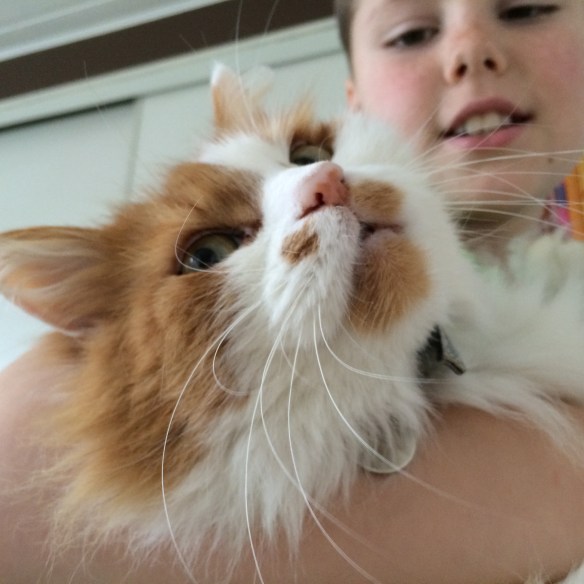
Today is a sad day, as Oliver the cat has left us. Most likely hit by a car, found by an old man out for a walk, who took the time to go knocking on the doors of the neighborhood. Answering the old gentleman with a ”Yes, I do have a red and white cat with a red necklace with a small bell on it”, I still had hopes it might be someone else’s cat.

The trepidation as I walked around the block, only to realize a few meters away, that yes, indeed, it was Oliver, sweet Oliver, lying there, in the grass. Kneeling down beside you. Caressing you. Picking you up with tears running down my face, I carried you home.

Oliver the cat

Home will be emptier without you.
Rest in peace, sweet Oliver.
You are forever in our hearts.


Podcast 19/52 – poetic tools

I listened to an On Being episode with composer Mohammed Fairouz, and immediately after listening to the edited version I listened to the unedited version, which was even better. Mohammed Fairouz is not a man I’d never heard of before, and I am glad that has been rectified.

He has a lovely positive outlook on the future, stating in no uncertain terms that he thinks the world will soon become a better place. Since I also hold that view, hard as it may be to stick to sometimes, given the barrage of negative news flowing all around, I exhale, and feel my body go a bit soft, relaxed, knowing there are many more people devoted to the same aspiration.

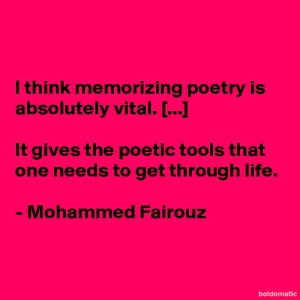
I’m going to say something that you may think me crazy to say. But I believe that the future is extremely bright. I believe that the future is hopeful. And I think that this generation is absolutely committed to making the world a better place. And I think they have the means to do it. And I think that if the world does not become a better place by the time that I’m 50 or 60, we have no one to blame but ourselves. We have the will. We have the drive.
– Mohammed Fairouz

It’s an episode that span large and far, in time, in space. Mohammed has a beautiful language, and I love the flow of the conversation. Mohammed says something which I’ve never heard and honestly never thought about. But it hit home somehow, and I’ve reflected upon it since I heard it. I believe there’s something there.

”Where”, you ask?
I reply ”Here”, and give you this:

BoldomaticPost_I-think-memorizing-poetry-is

Poetic tools. Isn’t that just a wonderful way to look at it? Poetic tools, do I even have any? I’m not sure I do. When spoken about this way, I sure get an urge to get myself some, don’t you?

What if I forgave myself?

Just finished watching Wild, the movie with Reese Witherspoon, based on the true story (made into a book) by Cheryl Strayed, who hikes the Pacific Crest Trail after her life unravelled following her mom’s death and a divorce.

Two things really hit home. One is kind of soft and mushy, romantic and drippy even. It’s what Cheryl’s mom used to say, possibly her life motto even:

sunset

I especially like that last line: You can put yourself in the way of beauty. And it’s simple, because beauty lies in the eyes of the beholder. So it is possible for me to see beauty everywhere. I can put myself in the way of beauty wherever I am.

The other thing from Wild that I take with me after watching it is something that I’ve reflected a lot upon these past months of the #cleanse4expansion-project: forgiveness.

What if I forgave myself?, I thought. What if I forgave myself even though I’d done something I shouldn’t have? […] What if what made me do all those things everyone thought I shouldn’t have done was what also had got me here? What if I was never redeemed? What if I already was?

For me, the process of looking at forgiveness generates the feeling of expanding, it’s transformative. And I know, there are more areas where the question lies dormant, waiting to be asked:

What if I forgave myself?

This blog post, number 70 of 100, is a part of the #blogg100 challenge currently running in Sweden

Thank you, Ed!

I just watched Citizenfour. From the get-go I had the feeling that this was gonna be one of those experiences which I would rather not have had, simply because I don’t want to live in a world as the one depicted. And it’s not just depicted as such, because it’s not a made-up story. It’s not fiction. It’s the way of the world.

But it’s not the world I want to live in. Sorry, but it just isn’t. Where some people deem themselves overlords over others. In some ways, I’m probably guilty of that myself – lording over others, people with lesser means than I have in one form or another. It still isn’t the direction I want to see the world evolve.

Anyway, watching this story of one man with such knowledge of what the system/s contain that he has no choice but to expose it, my heart goes out for him. But more than that, I am grateful for people like Edward Snowden and other whistleblowers, who put themselves at risk for the greater good.

BoldomaticPost_If-there-s-nothing-to-hide-thI am left with one lingering thought, which is likely the most naive stance to take, but yet, it’s my stance:
The only way to not have to worry about what get’s out where, is to be totally transparent. If there’s nothing to hide, there’s nothing you cannot stand for, is there? Then you wouldn’t have to sit at a congressional hearing and willfully lie to the people before you. You wouldn’t have to use shady ways of leaning on people to get them to back down and/or keep quiet.

But no, I don’t know if that’s even possible, if a government and it’s agencies can choose that path. I don’t know. Perhaps not. But I know I can. As an individual. Stand for what I do. Which doesn’t mean I display my every action, word, thought, but that I could. If called on them, I could. Because I stand for them, or at least that’s my intent. Being human, I stumble and fall, and take action in ways I regret, for sure, but that’s what being human is, isn’t it?

Anyway. I’d like to say thank you, Ed, for all that you did. For the risks you took, for the path of life – likely nowhere near the way you dreamt your life would turn out – you deliberately stepped upon, for the sake of us all. Thank you, Ed!

PS – Haven’t watched it yet? Do it. Just do it. Ok?

Podcast 18/52 – slow money while foraging

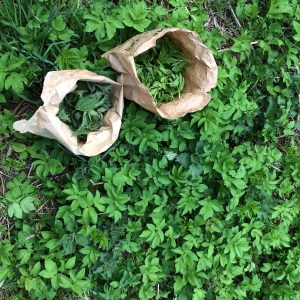
Today, as I was riding my bike home from singing with my choir in the church this morning, I stopped to pick stinging nettles and ground-elder. I am filling my freezer with quickly blanched nettles and ground-elder, to savor during the winter. And of course I am using the green gold on a weekly basis at home right now as well (green smoothies, pies and lots of other things).

nettles and ground-elder

So as I was picking I listened to Woody Tasch from Slow Money on Peak Prosperity, a podcast I’ve blogged about before. A lot of the episodes are way above my capacity, as it’s centered around economics, and I’m neither interested or knowledgeable about economics, I willingly admit. But this was really interesting. Slow Money is sort of the investment equivalent to Slow Food. In the words of the organization itself:

Slow Money catalyzes the flow of capital to local food enterprises and organic farms, connecting investors to the places where they live and “bringing money back down to earth”.

There’s been two episodes recorded with Woody, but I listened to the most recent one, from 2014, so scroll down a bit on the page to find it. 

And possibly, the reason this episode was right up my alley is perhaps because:

This is about culture. This isn’t about economics. It’s about what’s more important, economics or culture? And guess what? In the United States, we have spent the last hundred years proving to ourselves that economics is much more important than culture. 

And yes. It’s very deliberate that Woody speaks about culture, the word that both brings with it images of tilling the land, growing food and other useful plants, as well as the customs of the society I live and work in. And for me, it’s not an issue I have to think long and hard upon. Culture is more important that economics. Economics is a part of culture, and the culture within the economic system is part of the problem for sure. So there’s a challenge for us, to change that culture. That’s part of the reason why Peak Prosperity exist in the first place.

What’s more important for you? Culture or economics?

Bucket list?

I’ve never had an urge to write a bucket list. No idea why, just never felt like it. Until the other day. Then it suddenly popped into my head as something that I wanted to do. So I did, that is, I started to write one.

Yesterday I told my husband about it and read the items I’d put on it. Opened up for some interesting conversations. That in itself made it all worth it. Good conversation starter!

Then today, hubby told me there was one thing on my list that he would really like to do, and it’s something to do with the entire family. So who knows. Perhaps we’ll all go to this wonderful town within the next year or two:

Seattle

I visited there in September 2014 and would love to go back. So there you have it, one of the bullets on my bucket list. Do you have a bucket list? And regardless of your answer, why do/don’t you have a bucket list?

Felt by the heart

When I watched this clip, of kids with a blindfold, who are told to go find their mom amongst a group of six women, what struck me is the importance of all our senses.

Perhaps we don’t take the other senses into consideration as much as when sight is taken from us, as in the video here. But the love, oh, the love I see in the eyes of these women. Makes me want to shed a tear or two, out of pure joy at the connection I see displayed before my eyes.

Reminds me of the quote by Denzel Washington:

”Why do we close our eyes when we pray, cry, kiss or dream?
Because the most beautiful things in life are not seen but felt by the heart.”

Podcast 17/52 – lethal absence of hope

Here’s an episode of On Being with Krista Tippitt that I listened to first time around a couple of years ago. I recently listened to it again, and it affected me as much second time around. It’s with a Jesuit priest named Greg Boyle, famous for his work with gangs and gang members in and around Los Angeles. Perhaps you’ve heard about Homeboy Industries?

In the podcast, Greg Boyle describe what gangs are all about in this way:

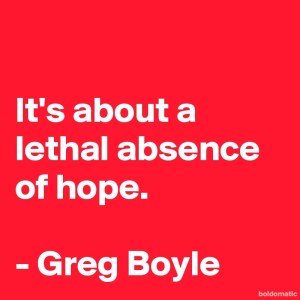
It’s about a lethal absence of hope. It’s about kids who can’t imagine a future for themselves. It’s about kids who aren’t seeking anything when they join a gang. It’s about the fact that they’re always fleeing something, always, without exception. So it shifts the way you see things. Somebody, Bertrand Russell or somebody, said, ”If you want to change the world, change the metaphor.” And that’s kind of how we want to — I think we need to proceed in something like this. So if you think it’s the Middle East, you’re quite mistaken. If you think it’s Northern Ireland, wrong again. It’s about kids who’ve ceased to care. So you want to infuse young people with hope when it seems that hope is foreign.

BoldomaticPost_It-s-about-a-lethal-absence-oA lethal absence of hope.

Oh, that’s powerful.
That hit me right in the gut.

And there’s so much more in this podcast, so please, take a listen. (And you can actually read it as well, but I do urge you to listen. There’s a feeling behind the words that is very apparent when listening to Father Greg speak about his homies.)

If what we are facing is a lethal absence of hope, and I don’t doubt it for a minute – what can I do? What can we do? What is there to do? And I don’t mean specifically about the gangs of Los Angeles. I mean about the lethal absence of hope that is visible everywhere. I don’t think there’s a country on earth, not facing just that somewhere or other within the confines of its borders. Do you?

So how to approach a lethal absence of hope?