Podcast 19/52 – poetic tools

I listened to an On Being episode with composer Mohammed Fairouz, and immediately after listening to the edited version I listened to the unedited version, which was even better. Mohammed Fairouz is not a man I’d never heard of before, and I am glad that has been rectified.

He has a lovely positive outlook on the future, stating in no uncertain terms that he thinks the world will soon become a better place. Since I also hold that view, hard as it may be to stick to sometimes, given the barrage of negative news flowing all around, I exhale, and feel my body go a bit soft, relaxed, knowing there are many more people devoted to the same aspiration.

I’m going to say something that you may think me crazy to say. But I believe that the future is extremely bright. I believe that the future is hopeful. And I think that this generation is absolutely committed to making the world a better place. And I think they have the means to do it. And I think that if the world does not become a better place by the time that I’m 50 or 60, we have no one to blame but ourselves. We have the will. We have the drive.
– Mohammed Fairouz

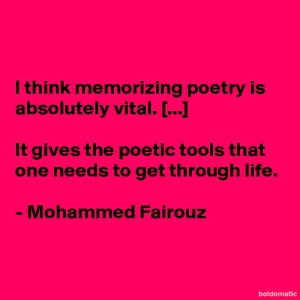
It’s an episode that span large and far, in time, in space. Mohammed has a beautiful language, and I love the flow of the conversation. Mohammed says something which I’ve never heard and honestly never thought about. But it hit home somehow, and I’ve reflected upon it since I heard it. I believe there’s something there.

”Where”, you ask?
I reply ”Here”, and give you this:
BoldomaticPost_I-think-memorizing-poetry-is

Poetic tools. Isn’t that just a wonderful way to look at it? Poetic tools, do I even have any? I’m not sure I do. When spoken about this way, I sure get an urge to get myself some, don’t you?

What if I forgave myself?

Just finished watching Wild, the movie with Reese Witherspoon, based on the true story (made into a book) by Cheryl Strayed, who hikes the Pacific Crest Trail after her life unravelled following her mom’s death and a divorce.

Two things really hit home. One is kind of soft and mushy, romantic and drippy even. It’s what Cheryl’s mom used to say, possibly her life motto even:

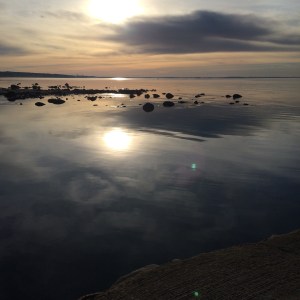
sunset

I especially like that last line: You can put yourself in the way of beauty. And it’s simple, because beauty lies in the eyes of the beholder. So it is possible for me to see beauty everywhere. I can put myself in the way of beauty wherever I am.

The other thing from Wild that I take with me after watching it is something that I’ve reflected a lot upon these past months of the #cleanse4expansion-project: forgiveness.

What if I forgave myself?, I thought. What if I forgave myself even though I’d done something I shouldn’t have? […] What if what made me do all those things everyone thought I shouldn’t have done was what also had got me here? What if I was never redeemed? What if I already was?

For me, the process of looking at forgiveness generates the feeling of expanding, it’s transformative. And I know, there are more areas where the question lies dormant, waiting to be asked:

What if I forgave myself?

This blog post, number 70 of 100, is a part of the #blogg100 challenge currently running in Sweden

Thank you, Ed!

I just watched Citizenfour. From the get-go I had the feeling that this was gonna be one of those experiences which I would rather not have had, simply because I don’t want to live in a world as the one depicted. And it’s not just depicted as such, because it’s not a made-up story. It’s not fiction. It’s the way of the world.

But it’s not the world I want to live in. Sorry, but it just isn’t. Where some people deem themselves overlords over others. In some ways, I’m probably guilty of that myself – lording over others, people with lesser means than I have in one form or another. It still isn’t the direction I want to see the world evolve.

Anyway, watching this story of one man with such knowledge of what the system/s contain that he has no choice but to expose it, my heart goes out for him. But more than that, I am grateful for people like Edward Snowden and other whistleblowers, who put themselves at risk for the greater good.

BoldomaticPost_If-there-s-nothing-to-hide-thI am left with one lingering thought, which is likely the most naive stance to take, but yet, it’s my stance:
The only way to not have to worry about what get’s out where, is to be totally transparent. If there’s nothing to hide, there’s nothing you cannot stand for, is there? Then you wouldn’t have to sit at a congressional hearing and willfully lie to the people before you. You wouldn’t have to use shady ways of leaning on people to get them to back down and/or keep quiet.

But no, I don’t know if that’s even possible, if a government and it’s agencies can choose that path. I don’t know. Perhaps not. But I know I can. As an individual. Stand for what I do. Which doesn’t mean I display my every action, word, thought, but that I could. If called on them, I could. Because I stand for them, or at least that’s my intent. Being human, I stumble and fall, and take action in ways I regret, for sure, but that’s what being human is, isn’t it?

Anyway. I’d like to say thank you, Ed, for all that you did. For the risks you took, for the path of life – likely nowhere near the way you dreamt your life would turn out – you deliberately stepped upon, for the sake of us all. Thank you, Ed!

PS – Haven’t watched it yet? Do it. Just do it. Ok?

Podcast 17/52 – lethal absence of hope

Here’s an episode of On Being with Krista Tippitt that I listened to first time around a couple of years ago. I recently listened to it again, and it affected me as much second time around. It’s with a Jesuit priest named Greg Boyle, famous for his work with gangs and gang members in and around Los Angeles. Perhaps you’ve heard about Homeboy Industries?

In the podcast, Greg Boyle describe what gangs are all about in this way:

It’s about a lethal absence of hope. It’s about kids who can’t imagine a future for themselves. It’s about kids who aren’t seeking anything when they join a gang. It’s about the fact that they’re always fleeing something, always, without exception. So it shifts the way you see things. Somebody, Bertrand Russell or somebody, said, ”If you want to change the world, change the metaphor.” And that’s kind of how we want to — I think we need to proceed in something like this. So if you think it’s the Middle East, you’re quite mistaken. If you think it’s Northern Ireland, wrong again. It’s about kids who’ve ceased to care. So you want to infuse young people with hope when it seems that hope is foreign.

BoldomaticPost_It-s-about-a-lethal-absence-oA lethal absence of hope.

Oh, that’s powerful.
That hit me right in the gut.

And there’s so much more in this podcast, so please, take a listen. (And you can actually read it as well, but I do urge you to listen. There’s a feeling behind the words that is very apparent when listening to Father Greg speak about his homies.)

If what we are facing is a lethal absence of hope, and I don’t doubt it for a minute – what can I do? What can we do? What is there to do? And I don’t mean specifically about the gangs of Los Angeles. I mean about the lethal absence of hope that is visible everywhere. I don’t think there’s a country on earth, not facing just that somewhere or other within the confines of its borders. Do you?

So how to approach a lethal absence of hope?


Podcast 16/52 – on courage

Until now I’ve given you recommendations from the One you feed, On Being, RSA, Invisibilia (from NPR), Good Life Project, Peak Prosperity and London Real. Today I give you a new podcast in this Sunday podcast tip-series of mine.

A while ago I discovered the TED radio hour on NPR. It’s an hour long radio show, where they find four TED Talks that have a common theme, and make it all into great radio. I’ve been listening to a few episodes lately. Several of them are now on my tip-list in Evernote, where I keep track of the podcasts I’ve already recommended and the ones I want to recommend.

BoldomaticPost_Do-you-notice-the-small-actsOne of the episodes is on courage, and that’s a word and a concept that I think a lot about. What is courage? What makes people act courageously? Here are four takes on courage, from the ability to speak up, to work in war zones, to risk ones life by taking a stand for justice and by simply being a transparent physician and urging others to do the same. Four stories well worth listening to, I know I’m gonna check out the full TED Talks as well, that’s for sure!

And it makes me even more fascinated about the concept of courage. Spotting the grand gestures, the blatantly obvious courageous acts that make the headlines, that’s easy. No wonder we do that. Being easy to spot, they become the talk of the town.

But do I spot the small acts of courage, the ones I’m surrounded with on a daily basis?

This blog post, number 50 of 100, is a part of the #blogg100 challenge currently running in Sweden

Ord på sår

Jag vill att de ska förstå att det inte bara finns ett rätt svar som så ofta i skolans värld. Att det ska vara tillåtande att leka med språket via dikten. Tillåtande att låta det abstrakta samarbeta med det konkreta.

Ord på sår. En artikel i Sydsvenskans kulturdel som berör. En så ofantligt vacker och insiktsfull text om poesi, ord, lek & lärande, allvar och läkande, liv och död.

Jag har läst en text en tjej skrivit. Det kanske är det svartaste jag läst. Men jag ser det som ett friskhetstecken. Hon har upptäckt nyanserna i sitt språk och fäst sitt tankekaos på ett vitt papper. Jag uppmuntrar henne till att skriva. Skriv mot det svarta, för att komma till det ljusa!

Att sätta ord på sår. Artikeln jag lyfter fram bitar av, men den förtjänas att läsas i sin helhet. Så läs. Och låt dig beröras.

BoldomaticPost_Pa-alla-samtal-dar-vi-genom-d


Podcast 9/52 – Love and Sex and Attachment

Today marks the start of the blog challenge #Blogg100 in Sweden, and just as the last two years, I’ve decided to play. However, I have no real plan for doing anything other than what I normally do, which is blog daily…. but, who knows, I might think of something special as I go along.

However, today is Sunday, and it’s time for my ninth podcast tip, and I’m opting for an episode from On Being with anthropologist Helen Fisher, called Love and sex and attachment. I listened to the episode earlier this week, and just like a few other podcasts, immediately re-listened once finished. Today as I found the link for the episode I see Helen Fishers photo, and was a bit surprised. Her voice doesn’t sound like she looks. Have you ever experienced that? Anyway, that’s a side note.

Love, sex, attachment. I mean – you can’t really go wrong there, can you? It’s something we are all interested in and affected by. And that’s actually the reason why Helen got into this area of scientific enquiry in the first place, because she was so interested in that which ties us together, that which we all have a relationship to, the similarities between people, rather than that which separates us.

BoldomaticPost_relationships-evolve-and-a-goOne of the take away’s for me from this podcast is the ever-changing nature of relationships, and that it’s actually a sign of a good relationship, that it is constantly changing, growing, evolving. And you know why? Because life in itself is constantly changing – nothing is permanent. We have somehow gotten tricked into believing it is, or should be, but in reality, life is dependent on change, changing thoughts, changing needs, changing mental states, changing relationships. So how could we ever believe that any one person, or any one relationship, could be permanent? Is it a need for safety and security that have warped somehow? Perhaps due to the loss of the local community, that Krista Tippitt and Helen Fisher also touch on in the show?
 

Kids for cash

We’ve got to see this documentary, my husband told me. So we did. Last night. It’s called Kids for cash, and it’s well worth a watch. But if you’re anything like me, you will be horrified at what you will witness.

If you’re in Sweden, the documentary is available another month on SVT Play. Otherwise you can find out how to watch it here on the official website for Kids for cash.

I won’t tell you the details, because I’d rather you watch it yourself, but honestly, how in the world can anyone believe that what doesn’t work with adults will work with teenagers, whose brains aren’t even fully developed yet?

What I am talking about is deterrents. Hard punishments. Putting people behind bars, to scare other people not to head down that road. It doesn’t work. It never has worked, as far as I know, but it certainly doesn’t work now. And if it doesn’t work for adults, why on earth would it work for children?

Oh these poor children, and their families. What were they put through, and for what? For WHAT?

kids for cashAs the credits are rolling at the end of the movie, Creep playing in the background, I sing along to:
But I’m a creep
I’m a weirdo
What the hell am I doing here?
I don’t belong here
I don’t belong here

… with two cats in my lap, and I think:

What kind of a world are we creating? Surely this isn’t as good as it gets? Surely both you and me can do better than this, be better than this?

Podcast 8/52 – Dinner with Einstein, Jung and Herbie Hancock?

Listened to this episode of Peak Prosperity the other day, and since then have listened to it another two or three times. It’s a conversation between Christ Martenson and Andrew ”Treebeard” Graves on becoming the change we wish to see, and exploring the development of inner resilience.

And they go deep into stuff that really resonates with me in many ways. Sometimes perhaps simplifying a bit much, but still, there’s a lot of what they speak about that I agree with.

So, since I’ve talked and written much the past quarter on listening for that which I don’t already know, I’m now challenging myself to write about what I heard that was new to me… hm, let’s see… *reading through the transcript of the podcast, trying to find something that sticks out as new to me*

First of all, listening to this conversation as such, on a podcast such as Peak Prosperity surprised me, but also made me quite happy, because I’m hoping it will resonate with the Peak Prosperity community, and will lead to even more people actually starting to look within.

And also, I’d like to join in on that dinner conversation with Einstein, Jung, Herbie Hancock and Chris Martenson. I sort of knew Albert Einstein have said something like this: “People think I had these great ideas, but it was not me. I just opened myself up and creativity flowed through me. I was a vessel.” but I had no idea Carl Jung and Herbie Hancock felt the same. I actually had to google Herbie Hancock, because I’ve never really listened to him. Found a great tune quite fitting to the theme of the podcast itself actually:

Imagine all the people living for today.
Imagine all the people living life in peace.
Imagine all the people sharing all the world.

Now there’s a vision to dream of.
I do. I dream of that, and I try to act it too. I see the potential for it, the possibility that exist in every moment. A world where we live as one. And becoming the change we wish to see in the world is the only way to get there, I believe. Do you?

Podcast 7/52 – Releasing criticism

During the Christmas holidays I took long solitary walks along the beaches off the coast of Vejbystrand, where my mother lives. Beautiful landscape, highly varying weather, and great podcasts to keep me company, vejbystrandwhen I didn’t feel like walking in silence.

One of the podcasts I listened to was this one, the Good Life Project-interview with Tara Sophia Mohr, who said something to the likes of this:

Feedback tells me nothing of me, and everything about the person giving it. 

And I stopped in my stride. Went back on the podcast, and listened again, and yup, that’s what she said, Tara. That the feedback she get’s tells her everything about the feedback-giver, and nothing about herself.

Wow. I giggled a little to myself, and could imagine the amount of energy I’ve wasted on fully diving headlong into someone else criticism and feedback about me – taking it for truth. Scary almost, now that I think of it.

Now, she made it clear, that just because she doesn’t believe feedback tells her something about her, that she’s not interested in hearing it. On the contrary, she’s extremely interested in it – just because it tells her so much about those she’s interacting with.

Come to think of it, it’s been a while since I listened to this episode of Good Life Project, and I think I might take my own recommendation and re-listen to it the upcoming week.

What do you make of her statement? Agree? Disagree?