
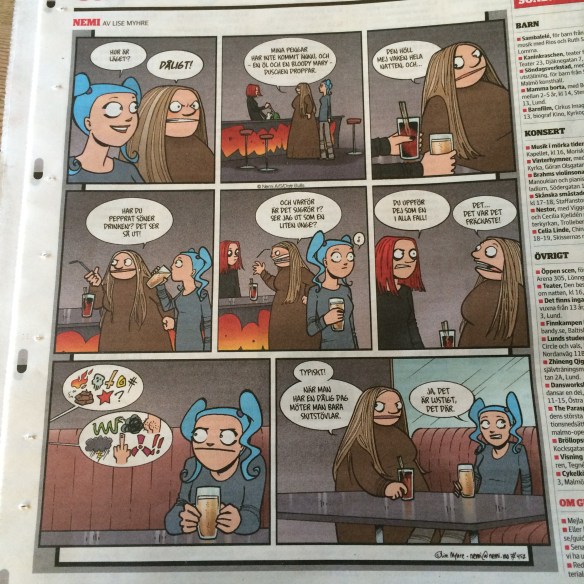
Typiskt! När man har en dålig dag möter man bara skitstövlar.

Häromveckan skrattade jag högt åt Nemi i Sydsvenskan, det måtte varit en söndag eftersom det är versionen som inte enkom är en strip utan nästan en hel baksida av kulturdelen. Tog raskt ett foto och tänkte Det här måste jag lägga upp på bloggen! Så då gör jag det:
Nemi

Jag hoppas du kan läsa. Om inte kommer här själva poängen (sista rutan):

Typiskt! När man har en dålig dag möter man bara skitstövlar.

Ja. Just precis så är det. Och vet du varför? För när jag har på mig jag-hatar-världen-för-alla-är-idioter-glasögonen på mig, ja, då ser jag ju världen genom de glasögonen och allt jag upplever färgas av min sinnesstämning i stunden.

Och lika sant är det då att när jag har på mig jag-älskar-världen-och-jag-älskar-alla-människor-för-de-är-underbart-mänskliga-allesammans-glasögonen på mig, ja, då ser jag ju världen genom de glasögonen och allt jag upplever färgas av min sinnesstämning i stunden.

Grejen är att jag har dessa, och en sjudundrandes massa andra glasögon i min garderob, och det är inte alltid jag är medveten om vilka som hamnar på nästippen. Men när jag blir medveten om vilka glasögon jag ser världen genom, så blir också världen och jag själv, lite enklare att fördra. För när jag upptäcker att jag sitter där med mina alla-är-en-idiot-glasögon på så är det nästan som om de liksom löses upp och försvinner i det blå och lämnar plats åt några nya. Och då kan ett annat par glasögon närmast magiskt hoppa upp på nästippen min, och så upplever jag världen helt annorlunda än alldeles alldeles nyss.

Så är det. I varje stund upplever jag världen utifrån den sinnesstämning och de tankar och känslor jag har. Har du tänkt på vad det betyder egentligen? I. Varje. Stund. 

Själv vet jag detta. Men likförbaskat fastnar jag ibland i tron på att det finns vissa undantag. Snurrigt det där. Som om gravitation vore ett tillval jag kunde göra, när det passade mig liksom. Så är det ju inte (med mindre att jag befinner mig i omloppsbana en god bit från jorden eller något dylikt), utan gravitationen påverkar mig i varje stund, oavsett om jag är medveten om den eller inte. Så funkar min upplevelse av världen också.

Fast ibland vore det bra skönt om gravitation och det faktum att min sinnesstämning i varje stund avgör hur jag uppfattar världen runt mig kunde vara tillval, om så bara för en minut eller två, eller hur?
 

A leap of faith

I normally don’t blog more than once per day, but Christer Hellberg shared this TED Talk on Facebook, I watched it and I just have to share it with you. So give yourself 22 minutes and sit down and watch Ricardo Semler here:

Some priceless quotes from the talk include:

If you’re giving back, you took too much. 

Why do I want to be remembered at all?

The fact is, what we do with education is totally obsolete.

Ask three why’s in a row. Because the first why, you always have a good answer for. The second why, it starts getting difficult. By the third why, you don’t really know why you’re doing what you’re doing. If you do this, you might come to the question: What am I doing this for?

It takes a leap of faith about loosing control. And almost nobody who is in control is ready to take leaps of faith. 

Dad, why do we exist?

But those are just a few highlights. Listen and see what you hear.

Now, I’ve abandoned the notion of control a few years ago. I’m leaping. You?

Playing an instrument

Boy, am I lucky I slaved away at the piano as a kid, when I see this:

Now. Honestly. I never did amount to much, on the piano, even though I played it for like… 10-12 years or something. I just never managed to get fluent somehow, always having to struggle with learning the music from the sheet music.

I do sing a lot though, and have done, almost since the same time I started playing the piano. Possibly not the same thing, brain-wise, but still great fun and being a part of a choir is a super duper health boost!

And you know what? I promised myself I’d learn to play the guitar this year, and am strumming along, having learned a handful of chords. Now busy at trying to learn to progress between the chords in a fairly quick manner so I can play rhythmically.

Still a long ways to go though. But yeah, I can definitely see how (and why) playing an instrument will be like fireworks in the brain, in the very best sense of the word fireworks, at that. Can you?

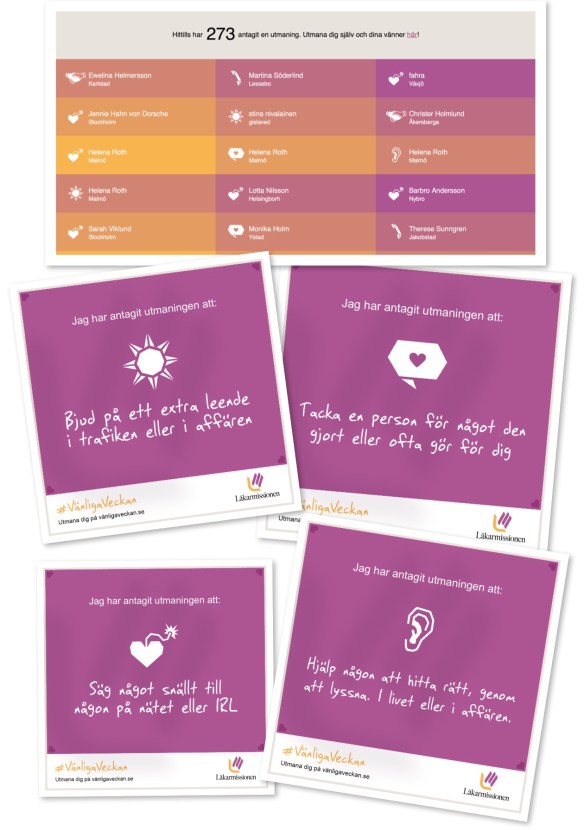
Vänliga Veckan – antar du utmaningen?

Wivan la upp en status på Facebook om Vänliga Veckan, klickade genast vidare och kom till Läkarmissionens utmaning. Och eftersom jag både gillar vänlighet och utmaningar, så klickade jag raskt in mig på fyra stycken:

Vänliga veckan

Visste du att Vänliga Veckan är en tradition med anor? Kolla in själv: http://vanligaveckan.se/om

Själv hade inte en aning om det, men det gläder mig, eftersom vänlighet, i det lilla, kan göra så enormt stor skillnad. För båda parter. Både den som ger vänligheten och den som tar emot den, har glädje av vänligheter. Jag hoppas därför att även du antar utmaningen och kollar in sidan, så kan vi hjälpas åt att sprida värme, kärlek och vänlighet under veckan. Och kanske det skapar en ny vana hos mig, och dig, och så fortsätter vi sprida glädje, även efter att #vänligaveckan tar slut.

Är du på?

Podcast 6/52 – The disembodied western culture

On Being is, as you might have guess, a favorite of mine, when it comes to podcasts. And this episode is as good as the next. Because they truly all have something special.

In this episode I met Bessel van der Kolk for the first time, and just from spending fifty minutes with him and Krista, I know I would love to listen more to him. He’s an interesting man, and I would love to meet him, talk to him, listen to him tell me more about what he’s discovered during his life.

There’s a part of the show, near the end, where Bessel and Krista talk about the disembodied Western culture, and I’ll just let you read for yourself:

DisembodiedDR. VAN DER KOLK: … Western culture is astoundingly disembodied and uniquely so. Because of my work, I’ve been to South Africa quite a few times and China and Japan and India. You see that we are much more disembodied. And the way I like to say is that we basically come from a post-alcoholic culture. People whose origins are in Northern Europe had only one way of treating distress: that’s namely with a bottle of alcohol.

North American culture continues to continue that notion. If you feel bad, just take a swig or take a pill. And the notion that you can do things to change the harmony inside of yourself is just not something that we teach in schools and in our culture, in our churches, in our religious practices. And, of course, if you look at religions around the world, they always start with dancing, moving, singing …

MS. TIPPETT: Yeah. Crying, laughing, yeah.

DR. VAN DER KOLK: Physical experiences. And then the more respectable people become, the more stiff they become somehow.

Disembodied. Stiff. Detached from ourselves.

Watched The Imitation Game for the second time the other day, and flinched at the ”stiff upper lip”-reference the head master makes when telling the teenaged Alan Turing about his friend Christoffer passing away during a holiday. I flinched, and feel very sad. How much pain have we, as a culture, not inflicted upon each other, by using words and phrases like that, setting that as the norm; being highly disembodied, clearly making it the thing to strive for.

And I think, even though Alan Turing must have been a school boy during the 20s, that it’s still so to a large extent. Rather than make use of our body for learning, school children in many many places are still told to sit still. Disembodied, that’s the culture we live in. And this is just one example, I’m sure I could come up with a number, if I wanted to. I don’t though.

Because perhaps there is a change coming? What with new research such as neuroscience, and new discoveries on learning, physical and mental development etc. Dare I hope?


The Imitation Game

A few weeks ago I watched The Imitation Game, and was deeply touched by it. Watching it at the movies, At the movie theater, after my emotional breakdown. when the final minute was up, I was crying my heart out (as you can see in the snap shot selfie I took of my puffy face and red eyes). Fully aware I was in a movie theater, it didn’t really feel like the space to have an emotional breakdown, so I tried to regain my composure. Luckily, my company at the time, took a look at me, and knew precisely why I was crying hard. She said ”The things we humans do to each other”, or something similar. And yup. That was the thought running over and over in my head:

The things we do to each other.

Today I watched the film again. It’s as good. Or perhaps even better. I didn’t fall into complete heartbreak at the end this time around though, but a few tears were shed, not surprisingly. I strongly suggest you watch the movie.

And again. My head keeps on churning on the things we do to each other… Why oh why? Why do we do the things we do to each other? The bad things, the nasty, evil, inhuman and horrendous things we do to each other?

no one can imagineBecause, man, are we ever missing out! Here’s a genius, who…. no. I don’t want to spoil the movie for you, if you haven’t seen it yet. But suffice to say, without him, the world would indeed be a very different place than the world we live in today. And it would have cost a lot more human lives at that.
And Alan Turing is but one example. He made a huge contribution to mankind, but what about the rest, who perhaps are shut down – and there are many ways of doing just that! – before being able to share their gifts with the world? What unimaginable things are we missing out on? Can we really afford to continue this way, where the norm and the normal are for ever deemed ”the way to be”, and if you are not within that ever narrowing spectrum, we shut you out, ignore, ridicule, bully and harass you?

Why, oh why, do we do the things we do to each other?

Jojka mera! More joik!

Du har säkert sett den, Jon Henriks vackra och själfulla jojk i Talang 2014. Eller så har du inte sett den. Sett förresten, det är lyssna du ska göra. Oavsett om du hört den förut eller ej. Klicka på PLAY, lyssna till hans berättelse, och sen sluter du ögonen när jojken börjar.

Det blir inte mycket vackrare än så, eller hur?

———————-

You’ve probably seen it, the beautiful and soulful joik performed by Jon Henrik on Talang (Got Talent) in 2014. Or you haven’t seen it. And seen…. you should listen. Regardless if you know what this is or you don’t. Press PLAY, listen to his story (English subtitles available), and then you close your eyes when the Sami joik begins.

It doesn’t get more beautiful than that, does it?


Podcast 5/52 – Autism at work

It’s Sunday, and Sunday means podcast-tip of the week. This time, a program I listened to almost a year ago, but it’s stayed with me. It’s an RSA Event entitled Autism at work: Releasing Talent and Harnessing Creativity. It’s not an easy listen, perhaps, but do give it a chance. If you do, I believe you will hear something new.

I remember taking a walk while listening, getting frustrated and elated both. Frustrated because there is so much human potential that goes to waste, basically because of lack of understanding and knowledge. Elated because there is hope at the end of the tunnel, this program give examples of companies really thinking about what their needs are, and realizing people within the autism spectrum are spot on for those needs.there is a place for everyone

Now, that might seem callous of me, as if the only way to have worth on this earth is if you are employed and somebody can directly utilize your skills. That’s not what I mean, so please don’t misunderstand me here. Rather, opening up work places, organizations etc, for a wider spectrum of how human beings can be, with similarities and differences, hopefully will lead to a more allowing society.

I believe it to be an innate need of human beings, to belong. So what can be done, to enable more people to find their place and their crowd?

Podcast 4/52 – Invisibilia podcast

Invisibilia is a glimpse into a world you can’t see.

Listen.

Feel different.

Those are the final words on the ”About Invisibilia”-webpage. I’ve listened to the three first episodes, and I am intrigued. It’s interesting, funny, astounding and sometimes downright horrible.

glimpse unseen worldsI could probably put each and every episode into a podcast-recommendation blog post, but it seems like it’s a series that really belong together, and since it’s just started to air, I’ll simply recommend you start with episode one, and if it get’s you hooked, do what I’ve done, and just continue!

The first one has the alluring title of The secret history of thoughts, and I greatly enjoyed listening to it. I agree with some of the stuff, totally disagree with some other things, and overall had a great time listening. I actually relistened to the episode the other day, and the second story about the locked-in man is especially fascinating.

Just listen. Maybe you’ll hear something you’ve never heard before when you listen. Ready for a glimpse into a world you can’t see?