9/24 – A game of survival

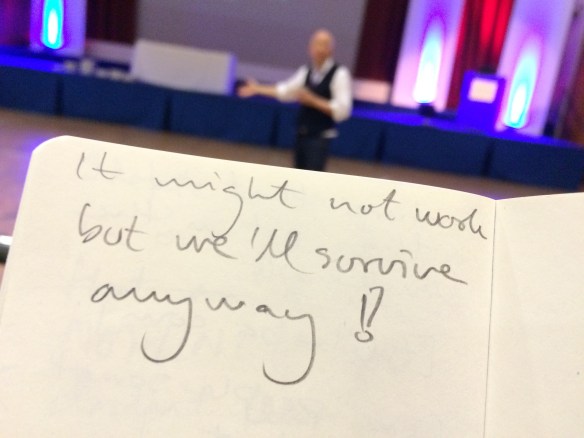
survive

Look at the world, right this moment, with millions on the run, from famine and terror, from war and discrimination. Families torn apart. Young children travelling alone for months on end, in the hope of getting to a safe haven, somewhere. All alone, far from their parents and other loved ones.

There are those who’s survival actually hinges on the choices they make.

But if a business gamble fails for you and me, what’s the worst that might happen? A set-back in time, a lost investment, but really – nothing truly important. Such as not being able to put food on the table for your children, having them go to bed hungry, perhaps even starving. The risk of imminent death is a reality for many on this planet, and they have to be very careful not to make rash decisions, gambling with the life of themselves or their loved ones.

But for you and me? What if I go out on a limb, and it doesn’t work out? There’s always another option. I can get a job, if need be. I can save up enough to pay back my debt and then some, so I can go out on a limb again. I can try, and try again. Over and over. And I know that my children do not run the risk of starving to death, because I choose to try this or that.

It’s simply not a game of survival for you and me.

So why then are we so afraid to try?

Reflection #9 of 24 from the notes I took and the experience I had at the Seth Godin Q&A-session in London, November 2015. These reflections will constitute my Advent Calendar for 2015, and will be posted daily from December 1st to the 24th.

8/24 – Putting life on pause

reassurance

Do you think I should do this? Or that?
What do you think of this? Or that? 
Which one do you thing I should choose? This one? Or that one?

Reassurance. Asking for someone outside of yourself to make your choice for you. In a sense, that’s actually what it is. Putting the power over your life and your choices, in the hands of somebody else. What for?

You run the risk of being put on pause. On hold. Waiting for the response from your father, wife, boss, co-worker, teacher or best friend. Not being able to move on, using the energy of the moment, because you are… what? Afraid you might make the wrong decision? Might pick the wrong thing? Walk down a path you should not have chosen?

Letting others choose for you might seem like an easy way to live life. But is it really your life then?

Reflection #8 of 24 from the notes I took and the experience I had at the Seth Godin Q&A-session in London, November 2015. These reflections will constitute my Advent Calendar for 2015, and will be posted daily from December 1st to the 24th.

7/24 – Learning is da shit!

My daughter told me over dinner the other night, that a lot of her friend’s parents are pushing them hard for good grades, using threats of not getting to do or have stuff they want and so on. So when she said ”I am so happy you don’t push me that way. I know you are happy if I do my best, and learn as much as I can, regardless of the grade I get”. standard

So in a sense, I’ve been striving towards this family standard that Seth spoke about, quite a few years by now.

I asked my daughter: If you would get top grades but not learn a lot, or not so good grades but learn a lot, which do you think I’d opt for? She replied immediately, picking the latter choice. And she’s right. Learning is much more important for me than grades. Grades might (and should!) be a reflection of how much and well you learn, but really, I don’t think that’s how they work at all. You can learn an astonishing amount of stuff, and still get a low grade. It all depends upon your starting point, doesn’t it? Unfortunately the effort put into learning isn’t taken into consideration in grades.

Asking for, and praising, top grades, might be a strategy that backfires on you, as a parent. You run the risk of promoting external motivational factors, rather than encourage inner motivation. Instead, ask for, and praise, learning and the work your child (and yourself!) puts into it!

Reflection #7 of 24 from the notes I took and the experience I had at the Seth Godin Q&A-session in London, November 2015. These reflections will constitute my Advent Calendar for 2015, and will be posted daily from December 1st to the 24th.

6/24 – Podcast 49/50 – Taking a risk

I didn’t want to give up recommending a podcast Sundays in December on account of the Advent Calendar I’m running with quotes from #SethinLondon, so I realized I might as well find some podcasts with Seth that I haven’t recommended before (because I’ve recommended several before: this 4-part blog with Seth at On Being, and this one from GLP.)

Seth Godin London Q&A by Rajesh Taylor

Seth Godin London Q&A by Rajesh Taylor – did we ever have a blast that day!

So I googled. And got lucky. There’s a multitude of podcasts featuring Seth Godin! And I can understand why, since he’s an interesting person to have a conversation with. I started to listen to Smart People Podcast and have to say, even though the episode with Seth is from 2013 I think, it’s definitely a ”conversation that satisfies my curious mind” which is their tag line.

At the end of this podcast, Seth actually talks about what I’ve been starting to do this past year, which is, to not just go for ”the next, the next, the next” all the time. Rather, I rarely listen to a podcast, to give an example, but once anymore. I almost always listen at least two, and often three or four, times. This podcast is no exception. On my second listening, I heard more. Deeper. More profoundly.

If you’re into school and learning, sharpen your ears especially about 19 minutes into this podcast. It’s good. And I mean G O O D what Seth says there!

But. My absolute takeaway from this podcast is a simple mantra. I wanted to find the spot, so I’ve been listening, and re-listening, while packing for a trip, and I simply cannot find it. Makes me wonder if I heard it somewhere else, which is a definite possibly as I’ve been listening to a lot of Seth these past days.

Anyway. I know Seth talked about this (somewhere!), and what I heard was something that goes like this: Every day try to be generous in a risky way.

That really spoke to me. Generous in a risky way. Going out on a limb. Not walking the straight and narrow. Au contraire. Taking a risk, with the definite aim at being of service.

Now.
How do you do generosity in a risky way?

Reflection #6 of 24 is a bit of an odd ball, as it’s not from the notes I took and the experience I had at the Seth Godin Q&A-session in London, November 2015. Rather, this is a reflection on a podcast with Seth Godin. These reflections will constitute my Advent Calendar for 2015, and will be posted daily from December 1st to the 24th.

5/24 – What is school for?

How do I as a parent prevent my kids from loosing their inspiration?
Should I take my kids out of school?parents at fault

Now, if you’ve followed Seth you know he is a staunch critic of the current school system, but besides the fact that it’s a industrialist system designed (originally) to produce compliant cogs, he actually took me a bit by surprise here. Because he blames parents. (Now I’m not into blame games normally, but he has a point.) Parents should be asking what is school for, of everybody, anyone with a power to make changes, on all levels. And since everybody actually does influence somebody else, this really is something to ask of everybody.

What is school for?

Or, to use the twitterified question of the Swedish movement #skolvåren (translates to school spring): #WhySchool?

But, the real answer to the question affected me even more. Seth said that there is one thing that he loves about public schools and that is the fact that it’s such a mix. Where a kid from the projects can sit next to a kid with a billionaire mother. A kid with five older siblings, who never got a brand new piece of clothing in his life, can sit next to an only and severely spoilt child. (Perhaps a current risk we are facing is that the eclectic mix seems destined to become a thing of the past, the way the school system is run at the moment?)

So rather than think that you have to take your kid out of school, look at what you can do outside of school. In the afternoons. Weekends. Holidays!

Edit Wikipedia articles together, help your kids set up a blog to write in, give them a camera, buy them (or you all) a Raspberry Pi to experiment with, go to museums and art galleries, play together, read books, write books! Join a local toastmasters club, play instruments and sing together, travel the world, or go walk-about on roads in your local area that you’ve never walked along before. Grow vegetables in the garden, or sow a sunflower seed in a small pot of soil, get chickens for your backyard, cook together. Have fun! Live, love, laugh!

So even though, generally speaking, we don’t have a school system designed to create free-range kids, that doesn’t mean your kids can’t become free-range kids anyway. (What a free-range kid is? Check out this post: Part 4, Seth at On Being!)

So just get cooking! Homeschool (or unschool if that is more to your liking) your kids after ordinary school is out for the day, the week, the semester, the year! There is so much more to life than school, and learning for life can take place just about anywhere and anytime. I think the reason this affected me such was that I’d somehow forgotten about this little fact. But now I’ve been reminded.

Reflection #5 of 24 from the notes I took and the experience I had at the Seth Godin Q&A-session in London, November 2015. These reflections will constitute my Advent Calendar for 2015, and will be posted daily from December 1st to the 24th.

4/24 – The urge to hide

I don’t even remember the question that led up to this:dolphin

”Oh no, not me, what should I say? What should I do? Do I look good? Is my hair ok? Who will see this, and what will they think of me?”

All those can be read into that ”Eh…” in the note I took.

In other words – human beings have a tendency to worry about what others might think, rather than just be in the moment, and go with what wants to happen.

Why is that? Where does it come from? And when does it come? Because surely we are not born with a detrimental and depressingly downputting self-deprecating inner dialogue?  One that we actually don’t have to listen to even, and still, it’s as if we think it’s telling the Truth. Why is that?

Reflection #4 of 24 from the notes I took and the experience I had at the Seth Godin Q&A-session in London, November 2015. These reflections will constitute my Advent Calendar for 2015, and will be posted daily from December 1st to the 24th.

3/24 – How do I do Trust?

One of the things that have really impressed me with Seth Godin is how he uses one element to navigate his work (and I presume life) by: Trust.

I remember listening to him in a podcast saying he determines what to do or not, by asking a simple question of himself: Does this scale trust? 
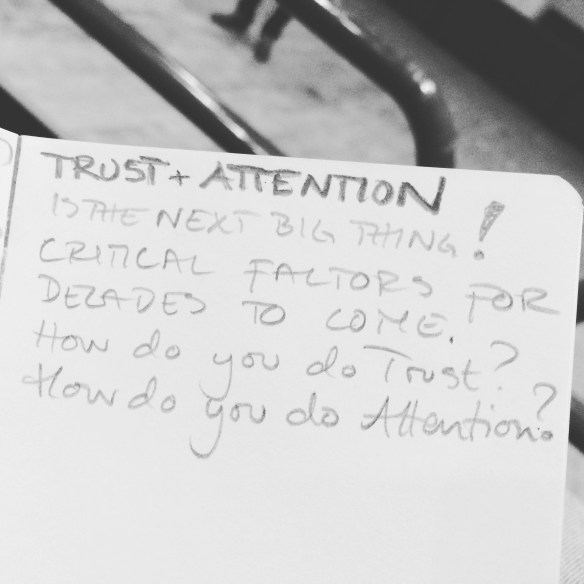
If the answer is Yes, he goes ahead. If No, he moves on to the next thing.trustSo when asked something akin to ”What will be the divider between those who make it and those who don’t, in the coming years?” he replied Trust and Attention. That is what will determine what we see, hear, shop, eat, where we work, the clothes we wear and so on in the decades ahead.

Now. I understand what he means with Trust, or so I believe at least. The level of trust I hold for someone, something, depend upon what they do, how they do it, and or me, why they do it in the first place. If there is coherence there, and it fits in with the way I show up in the world, I will trust.

But what does he mean with Attention?

Is it this: Those who works out a way to get attention from the masses, will be makers and shakers ahead regardless of what the product is? Somehow I don’t think so.

Might it be this then: Those who knows how to scale trust, and has a great product (a physical or digital object, a service, whatever your thing is) to put out into the world, will attract the attention of those who vibrate on the same frequency?

Or this: That which I put attention on is what I will see more of in the future?

Or something completely different?
I don’t know. What’s your take on it?

Reflection #3 of 24 from the notes I took and the experience I had at the Seth Godin Q&A-session in London, November 2015. These reflections will constitute my Advent Calendar for 2015, and will be posted daily from December 1st to the 24th.

2/24 – Love those bad ideas!

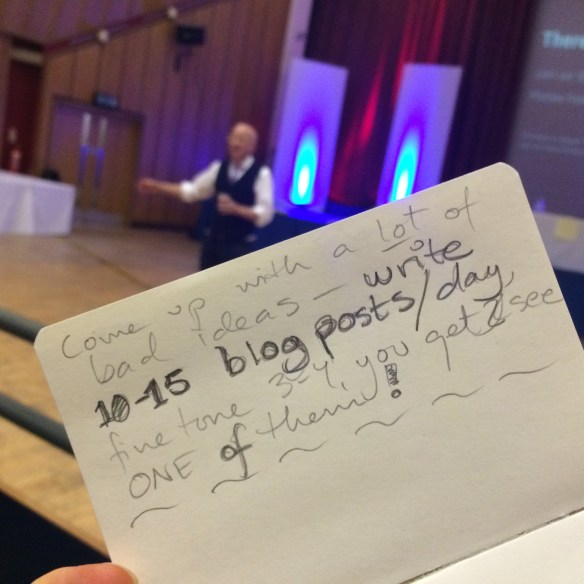
Seth Godin was asked how he manages to publish such great content on his blog, daily, without fail. His answer, short and sweet, was to come up with a lot of bad ideas.Note one #sethinlondon

What the world gets to see on his blog, is the result of a ruthless culling. Seth told us he writes ten to fifteen rudimentary blog posts a day, fine tunes three to four, and finally decided which is the best. That’s the one we, as his readers, get to see.

This chocked me. And from what I heard of my fellow participants at #SethinLondon, this was one of the things that really stood out for a lot of us.

I mean. I’ve set my sights on blogging daily, and I do, more or less. Have been doing it for soon to be three years now. But I’m still at that stage where I’m happy that I write one post. I mean, sometimes I do write more than one post, but rather than cull them from possible posts to publish on account of not being good enough, I save them for a day when my inspiration is lacking. Which means, you lot aren’t as lucky as the blog readers of Seth Godin are. His readers know what he publishes has been through a quality check, of sorts. My posts, very little quality control in my blogging process, I have to confess. I write, and then I publish. Seldom do I throw it away, thinking it’s not good enough to publish. But perhaps I should start to question my postings a bit more?

Oh well. I’m not putting myself and my blogging down though. I do learn. A lot. I mean, my writing is improving, based on this aim of mine to blog daily. But since I’m actually starting a new blog, solely in English, come the new year, perhaps I should set a higher standard with a lower frequency for that blog? Blogging three times per week, making sure what get’s published is up to the mark?

Reflection #2 of 24 from the notes I took and the experience I had at the Seth Godin Q&A-session in London, November 2015. These reflections will constitute my Advent Calendar for 2015, and will be posted daily from December 1st to the 24th.

1/24 – Merely begin.

Where do I start?
How do I know what is the right project, work, next step for me?
How do I know?begin

That was the gist of one of the questions asked of Seth Godin at #SethInLondon. And Seth beautifully answers:

Begin. 
Merely begin. 

It doesn’t matter what you pick, as long as you pick. That is the clinch, you see! Picking. Not what you pick. But the act of picking and then taking step one, step two, step three, and so on, putting your effort into whatever it is you picked.

I think as you get used to picking, you also get better at it, learning from previous picks that might have totally bombed, or just didn’t really feel right after a while. As long as you keep on picking and continue to move, to act, to do work that matters, stuff may or may not be smashing successes or total disasters. Keep on picking. And then. Most importantly: You begin.

Reflection #1 of 24 from the notes I took and the experience I had at the Seth Godin Q&A-session in London, November 2015. These reflections will constitute my Advent Calendar for 2015, and will be posted daily from December 1st to the 24th.

Slacklining through life

Have you ever tried slacklining? If you have, I know you know that balance requires constant movement. If you haven’t, imaging getting up on a small, flat nylon rope extended between two points. And then you walk. From one end to the other. If you are anything like me, and haven’t tried it before, you can’t.

I tried it this spring, and I almost wet my pants from laughing so hard during the experience. I figured I might be an ok rookie at this, but lo and behold, I didn’t even get up on the damned thing without grabbing onto my hubby’s shoulders for support. And then my legs went ballistic, wobbling back and forth like crazy. Hilarious. I just could not get them to stop… until all the wobble had gone out of them, and then, leaning heavily on hubby, I managed to walk a meter or two. That’s all. And it was damned hard.

But. And here’s the thing.

To keep your balance on a slackline, you have to be in constant movement, perhaps just minute micro movements, but still. If you were to stand absolutely still, you would not be able to stay on for a long period of time. It’s just not possible. People need to keep moving in order for balance to be maintained. Regardless if you’re on a slackline or not! Balance is an active state, it’s not passive at all.

Now. Imagine walking a slackline as a metaphor for life.

I think most of us aspire to some sort of balanced life. A little bit of play, building and maintaining strong relationships, loving and being loved, doing work that matters, having a meaningful pastime, and making a contribution to the greater good. More or less. This all requires movement. Physical as well as mental. With movement, you can deal with obstacles, you can get to know your friends better and deeper, or gain new ones. You learn and expand at work, gradually enjoying more and more complex and challenging tasks. And so on.movement

Without movement, on the other hand. What do you end up with? Imagine a relationship, where both parties are fixed in their ways and their thoughts. Stale, huh? At least that’s what comes to mind for me. Imagine never leaving your house. Never going for a walk. Not taking in anything new, no books, articles, movies, music, conversations. No play, experimentation or new sights.

Death. That’s what I perceive. Death.
Without movement, there is only death.

And even death, the real version, cheats us on this actually. Have you watched that clip of the compost degrading, while being filmed with a time-lapse camera? Watch it, it’s cool! And it shows that even in death there actually is movement. But it’s not active in the sense I’m pointing to, it’s the passive version.

So. If you want to live life, or you want to be able to walk from one end to another on a slackline, it’s vital to be in movement. That’s how you maintain a balance, making active choices, staying in movement, compensating for external as well as internal conditions (a sudden gust of wind, getting laid off). And, not to forget, sometimes we need support, and a lot of practice, and sometimes we can make do on our own, either through practicing until we’ve become proficient or even experts at something, or because we’re simply not aiming high enough, not going for something that will stretch our abilities to the fullest.

All this talk about slacklining has gotten me eager to try it out even more. This summer there were a few slacklines fastened around some trees in Bulltofta, not far from where I live, but I never tried them out. I hope they will be there this summer as well, and I promise I’ll make a go for it, an honest go at that! Wanna join me?