2/24 – Love those bad ideas!

Seth Godin was asked how he manages to publish such great content on his blog, daily, without fail. His answer, short and sweet, was to come up with a lot of bad ideas.Note one #sethinlondon
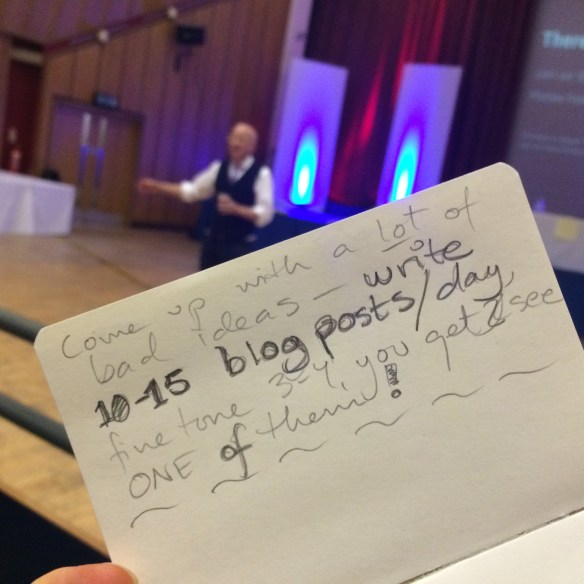
What the world gets to see on his blog, is the result of a ruthless culling. Seth told us he writes ten to fifteen rudimentary blog posts a day, fine tunes three to four, and finally decided which is the best. That’s the one we, as his readers, get to see.

This chocked me. And from what I heard of my fellow participants at #SethinLondon, this was one of the things that really stood out for a lot of us.

I mean. I’ve set my sights on blogging daily, and I do, more or less. Have been doing it for soon to be three years now. But I’m still at that stage where I’m happy that I write one post. I mean, sometimes I do write more than one post, but rather than cull them from possible posts to publish on account of not being good enough, I save them for a day when my inspiration is lacking. Which means, you lot aren’t as lucky as the blog readers of Seth Godin are. His readers know what he publishes has been through a quality check, of sorts. My posts, very little quality control in my blogging process, I have to confess. I write, and then I publish. Seldom do I throw it away, thinking it’s not good enough to publish. But perhaps I should start to question my postings a bit more?

Oh well. I’m not putting myself and my blogging down though. I do learn. A lot. I mean, my writing is improving, based on this aim of mine to blog daily. But since I’m actually starting a new blog, solely in English, come the new year, perhaps I should set a higher standard with a lower frequency for that blog? Blogging three times per week, making sure what get’s published is up to the mark?

Reflection #2 of 24 from the notes I took and the experience I had at the Seth Godin Q&A-session in London, November 2015. These reflections will constitute my Advent Calendar for 2015, and will be posted daily from December 1st to the 24th.

One word at a time – we change the world

Three young souls, with a desire to change the world, one word at a time. That’s a desire I want to support and aid, in any way I can. Because I have the same desire.

Belissa Escobedo, Rhiannon McGavin, and Zariya Allen, members of the Get Lit organization perform ”Somewhere in America” on The Queen Latifah Show.

The greatest lessons, are the one’s you don’t remember learning. 

One word at a time, we change the world.

One action at a time, we change the world.

The quality of those words and those actions, determine what the changed world will be like. It’s our choice, we are the creators! You. And I. Together, and separately.

What quality of words and actions have you chosen today?

Doing the right thing?

Åsa Minoz sent a link on Twitter the other day, as a response to a discussion on whether or not calling oneself PRO or ANTI actually makes any difference. Well, both me and Åsa believe it does make a difference. I am a pro-person myself, getting energized by the possibility to move ahead, to create, to reach something, somewhere. There are anti-people as well, who get equally energized by that position. We complement each other, in my view, and I am not (any more, thank god for that!) an advocate for My way or the highway.

Since I watched the clip that Åsa linked to, I have managed to send it to many people, because it’s just the most eloquent (and funny!) way to describe a system and its parts, so please, give Russ Ackoff 15 minutes, and watch/listen to him talking on Beyond continual improvement:

A few of the gems hidden within this talk, in my view, are these:

”If we have a system of improvement that is directed at improving the parts taken separately, you can be absolutely sure that the performance of the whole will not be improved.”

”Any process improvement effort 20140429-210259.jpgmust be focused on what you want, and not on what you don’t want.”

”Quality ought to contain a notion of value, not merely efficiency. That’s the difference between efficiency and effectiveness. Quality out to be directed at effectiveness. The difference between efficiency and effectiveness is the difference between knowledge and wisdom. And unfortunately, we don’t have enough wisdom to go around.”

Are you busy doing things right or doing the right thing?

What is quality?

Headed for Hässleholm for the first of four half day classes in Quality & Environmental Management Systems at a school for electro engineers. It’s the fourth year in a row I give this class (normally to automation engineers as well, but there are no 2-year students this year) and I love doing it.

After an introduction where we address our expectations on each other (teacher, student, the course itself) I let the participants start with a discussion on this question:

20140123-075814.jpg

It’s an interesting question if you think about it – because we all have so many preconceived notions about quality.

What’s your answer to the question what quality is?