
Just finished reading John Cleese autobiography So, Anyway… which is a book I recommend even for those who, like me, haven’t really got the British comedy scene from the 60s onwards down pat. One of the foremost insights I had when reading was how apparent it is that life unfolds, in mysterious ways, and how going with the flow of life can lead to fantastic careers, such as John Cleese’s.
But besides that, he talks a lot about writing (he sees himself first and foremost, as a writer rather than an actor), and stipulates a few rules for writing funny stuff, the second of which I really enjoyed reading:
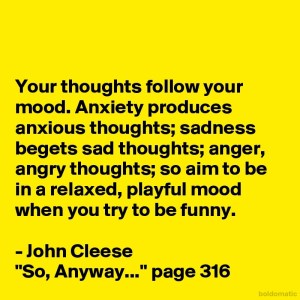
This I’ve found to be true: My emotions are a guide to my current state of mind, or mood, to use John’s words. I react to the world, from my current internal mindset, rather than have the outside world create my mood. I find this important!
It’s a bit like Groundhog day, you know, the movie with Bill Murray, where he keeps on reliving February 2nd, over and over again. The same things occur, and depending on his current internal mood, he’s happy, sad, angry, annoyed, depressed, frustrated about it. The same things. But his mood determines whether or not he perceives it to be good or bad, happy or sad, cheery or boring. This is true also in my life, as well as your’s, and is not a movie-feature.
If I’m in a miserable state of mind, I will see all things through that lens. It’s not the miserable things of the world that causes me to feel miserable. My mood tints the world into appearing miserable.
If I’m in a happy-go-lucky state of mind, I will see all things through that lens. It’s not the happy things of the world that causes me to feel happy-go-lucky. My mood tints the world into appearing happy-go-lucky.
One day I knock over a glass of water on the kitchen table and you would not want to be around me, for all the shouting, swearing and cursing going on, ruining my entire day and giving me ample evidence the whole world is out to get me. Another day, I laugh at my own clumsiness and after wiping it up just goes about my business, without a single cuss-word crossing my lips.
Have you experienced that as well, where the same things happened twice in a row, but your reaction is totally different?
 I like the reasoning behind fixed and growth mindset, possibly because I can recognize my own journey from (mostly) one to (mostly) the other. Luckily my direction has been from fixed to growth. For me, that is a huge part of the reason why my inner dialogue has gone from harsh to gentle, now that I think of it.
 HERO - the coach